 |
 |
 |
 |
 |
 |
 |
|||
 |
 |
 |
 |
| THE OFFICIAL FRANCIS E. DEC FANCLUB PRESENTS: | |||
|
THE
"MAXIMUM-CONVICTION APPEAL BRIEF" - FRANCIS E. DEC'S APPEAL TO THE U.S. SUPREME COURT |
|||
 |
- A LEGAL DOCUMENT WRITTEN BY FRANCIS E. DEC, ESQ. TRANSCRIBED BY zer0. | ||
 |
 |
||
|
|
zer0
SAYS: The material contained on this page is almost mythical. Those of you who have read Dec's rant "To All Judges" already know that he once sent a request for appeal (and for a writ of Certiorari) to the U.S. Supreme Court. Said letter of appeal is by Dec in his aforementioned rant referred to as his "MAXIMUM-CONVICTION APPEAL BRIEF" (probably in reference to the severity of his sentencing). Well, fans of Dec; this is that brief, added to the Fanclub at last. And god-fucking-damn-it is it ever long!! |
||
|
|
|
|
|
For a long time, this appeal brief was locked away and forgotten in some dusty archive somewhere. That is, up until 2006 when it was recovered by dedicated Decologist Ted Torbich. After several months of hard work, I have now transcribed and illustrated it fully. The result must be of the longest, most hate-filled pieces of writing Dec has ever cranked out; aimed at getting the Supreme Court of the United States to re-hear the case (see Timeline and FAQ) that lead to him losing his job as a lawyer by being disbarred from the NY Bar Association. It also contains one of the best examples of hate-fueled slander and proto-schizophrenic paranoia I have ever seen. Dec literally slanders every last living person who was involved in the trial against him in this damn thing! It's positively mind-numbing!! The more observant among you (possibly with a background in web design) will notice how there is no background image used on this page. The reason for this is very simple; Dec's Supreme Court appeal brief is so goddamn long that the image I use as a backdrop on the Fanclub starts to repeatedly loop itself over and over again due to the sheer vertical length of the page, in spite of said backdrop being more than 15 000 pixels in height! Yeah, that's a long-ass brief, alright! The humor in Dec's brief almost had me rolling on the floor the first time I read it. Besides his aforementioned hatred for precisely everyone, I utterly love the "pet names" he's got going on for the people involved in his trial, like Charles "felonious 10% kick-back" Martino or Fred "the car thief" Wirschning! My absolute favorite description, however, is of Nat Birchall. It's hard for me to see how Dec thought it was a good idea to point out how someone was standing "...PETRIFIED, AS IF AWAITING FATE TO END HIS MISERABLE PERJUROUS LIFE" in an official document he sent to the U.S. Supreme Court. But he did. Seriously. Maybe that's why the brief was turned down and the judgment in the case was not overturned. Man, I love Dec's style of writing so much! Funny as though it may be, this brief is also very dry in certain parts and contains a great deal of legalese. Also; Dec for some reason continually repeats himself throughout it, which in my opinion is very annoying. As such, even though this brief contains definite humor throughout, it may be too long even for some fans of Dec out there. If so, try reading this rant instead. It is based on this brief and contains a condensed version of the funniest parts in it. For your reading pleasure, I have highlighted parts of this brief that have struck me as funny in bold. Also highlighted in bold are some parts which struck me as slightly suspicious and which could possibly be interpreted as evidence of a real, honest-to-gosh Conspiracy against Dec by members of the Nassau County judiciary. When I first read Dec's lower courts appeal brief, I dismissed his accusations of a Conspiracy as the insane fantasies of a deranged mind. However, after having read this brief, I'm not so sure anymore. If at least some of the things he alleges actually did take place, there might actually have existed some kind of conspiracy towards Dec, possibly aimed at getting him excluded from the NY Bar by setting him up for a crime he did not commit. Don't take my word for it, though; read through the brief with a critical mindset and then decide for yourself. I have transcribed Dec's brief as carefully as possible. Dec sometimes includes other documents, such as receipts or letters sent to him from court personnel in his appeal. When this happens, I have inserted hyperlinked miniatures of these that you can click on to see the complete thing, so as not to interrupt the running narrative of his appeal. Enjoy, Parroting Puppet Gangster Slaves! |

 |
 |
 |
 |
 |
|
|
 |


|
|
NOTICE OF APPEAL TO THE SUPREME COURT OF THE UNITED STATES.
This appeal is taken pursuant to 28 U.S.C.A Section 1257, (1), and (3). Appellant was convicted of the crimes of Forgery in the Second Degree (two counts); Grand Larceny in the Second Degree and Violation of Section 1820 A Sub. 2 of the Penal Law, all in violation of the Penal Law of New York State, appellant was sentenced to Sing Sing Prison at Ossining, New York on each of the Forgery Second Degree convictions and on the Grand Larceny Second Degree conviction to a term of imprisonment the maximum of which was five years and the minimum two and a half years, all sentences to be served concurrently, and execution suspended and and [sic] sentence suspended on the last conviction. Appellant is presently serving probation, appellant has been automatically disbarred because of said conviction. II. The Clerk will please prepare a transcript of the record in this cause, for transmission to the Clerk of the Supreme Court of the United States and include in said transcript the following: All pre-trial motions, namely, Motion to Inspect the Grand Jury Minutes and Dismiss the Indictment, May 13, 1958; Motion to Dismiss Indictment, May 26, 1958; Motion to Resettle Erroneous Demurrer Order, July 8, 1958; The Court Reporter’s record of the trial and of judgment and sentence (two volumes); Motion to Amend the Fraudulently Altered Official Trial Record, seven hundred and ninety four (794) amendments, 320 typewritten pages, submitted to the Nassau County, County Court on September 14, 1959. Notice of Appeal to the Appellate Division of the Supreme Court for the Second Judicial Department and appeal motions, namely, Motion for an Order Commanding the Trial Stenographers to Produce the Trial Record in Accordance with Section 456 of the Code of Criminal Procedure, February 2, 1959; Motion to Dispense with Printing, February 2, 1959; Motion for an Order of Settlement on March 30, 1959; Motion to Extend Time to Amend the Trial Minutes, May 8, 1959; Motion to Extend Time to Perfect Appeal on October 5, 1959; Motion to Reargue Motion to Dispense with Printing on October 5, 1959; appellant’s and prosecutions appeal briefs and Court Order of transference to the Appellate Division of the Supreme Court for the First Judicial Department on October 11, 1960. Notice of Appeal to the Court of Appeals of New York and Motion to Dispense with Printing in the Court of Appeals on March 20, 1961; appellant’s brief and answering brief and Order of Affirmance of the Court of Appeals with no opinion of July 7, 1961, and all other papers in this matter. III. The following questions are presented in this appeal: 1. May a State consistent with the due process of law guaranteed by the Fourteenth Amendment to which guarantee is pertinent the right to a speedy trial, repeatedly adjourn a citizen’s criminal trial over a period of nine months in spite of the citizen’s duly undertaken repeated demands for a speedy trial as guaranteed by the Constitution. 2. May a State consistent with the equal protection and due process of the law guaranteed by the Fourteenth Amendment deprive a citizen of his statutory right to appellate review by producing a substantially fraudulently altered official trial record; which said trial record is obviously wantonly fraudulently deleted, abbreviated, juxta positioned, hashed together, jumbled and lengthened with substitute material in an obvious attempt to keep secret the gestapo like farce kangaroo court trial to support an unjust felonious conviction of the citizen, a volunteer Veteran of World War II and a member of the Bar of the State of New York. 3. May a State consistent with the equal protection and due process of law guaranteed by the Fourteenth Amendment uphold the felonious conviction of a citizen brought about through the halting of the cross examination of the completely breaking down and confessing perjurous chief prosecution witness, Mrs. Elizabeth Wirschning, wherein she through her sworn, detailed, cross examination testimony disproved the accusations of the false indictment created by and through the gestapo like frauds of the District Attorney and his staff and the Trial Court’s further ordering the alternation of said Elizabeth Wirschning’s cross examination with that of the near non-existent hearsay testimony of the near speechless, petrified, aged, perjurous, life long District Attorney’s stenographer, namely, Nathan Birchall, and then after halting both said cross examinations in spite of the citizen’s objections the court ordered the halting of the citizen’s trial for approximately one week during which week the citizen, defendant, was coerced through oral and written messages by Judge Philip Kleinfeld, a Judge of the New York State Appellate Division of the Supreme Court for the Second Judicial Department, the said messages warning the citizen defendant that regardless of the citizen’s innocence, the citizen must surrender his Constitutional Rights as a citizen and lawyer and give up trying his own case because both judge and jury were fixed and if the citizen did not retain a “chosen” ex District Attorney, namely, Edward Neary, as his lawyer to plead guilty to the false charges then the citizen’s trial would lead only to the citizen’s felonious conviction and a severe prison sentence because “the judge and jury are fixed”. 4. May a State consistent with the equal protection and due process of law guaranteed by the Fourteenth Amendment uphold a felonious conviction wherein the trial court in collusion with the prosecution and in spite of the citizen, defendant’s, objections withheld the contradictory sworn statements of complaint of the prosecution’s perjurous only two chief witnesses, namely, Mrs. Elizabeth Wirschning and Dr. Milton E. Robbins, especially when the withheld statements disprove the indictment of the citizen, defendant. 5. May a State consistent with the due process of law guaranteed by the Fourteenth Amendment uphold a felonious conviction of a citizen brought about by a trial wherein repeated statements by the trial judge and prosecutor claim directly and impliedly and through statutory definition that a hearsay, unverifiable copy of the District Attorney’s stenographic notes consisting mostly of hearsay conversations of others that the citizen defendant did [obscured] by the citizen defendant and thereby through statutory definition of criminal confessions practically convict the citizen defendant; when subsequently through written admissions of the prosecution in the prosecution’s appeal brief to the Court of Appeals of the State of New York the said District Attorney’s hearsay stenographic noted are stated not to constitute a confession, a contention obviously directly opposite to that taken by the prosecution and trial judge during the citizen’s trial. 6. May a State consistent with the right to due process of law guaranteed by the Fourteenth Amendment place in evidence and permit the prosecution to repeatedly read aloud to the jury during the citizen’s criminal trial copies of stenographic records of conversations of people other than the citizen who were never made witnesses during the citizen’s trial although they were available and two of whom were important members of the judiciary, especially when the District Attorney’s stenographer testified that that original stenographic records produced by the said District Attorney’s stenographer were written in his own personal secret code of shorthand which can be read and understood only by himself; and in spite of the citizen’s repeated objections the trial judge precluded any inspection of the said original stenographic notes and ordered the citizen to accept the veracity of the District Attorney’s stenographer’s stenographic notes on the say so of the District Attorney’s stenographer and further the said hearsay stenographic notes were falsely stressed by trial judge in collusion with the prosecution as a confession by the citizen, in that said citizen’s criminal trial that brought about the felonious conviction of the citizen. 7. May a State consistent with the right to equal protection and due process of law guaranteed by the Fourteenth Amendment procure a felonious criminal conviction against a citizen through the fraud and collusion of the trial court in conspiracy with the prosecution 8. May a State consistent with the right to equal protection and due process of law guaranteed by the Fourteenth Amendment deprive a citizen of liberty and property through a felonious conviction and intentionally ignore the explicit statutory protection afforded by Section 456 of the Code of Criminal Procedure for New York State, which said section provides that the trial record upon conviction shall be produced within the maximum time of 12 days after notice of appeal has been served and further intentionally disregard the said statutory rights in spite of the citizen’s formal written appellate court motion for an order compelling the trial court stenographers to produce the trial record in accordance with said Section 456 of the Code of Criminal Procedure in order to minimize the time in which court officials would have to fraudulently alter said citizen’s trial record, wherein support of said motion detailed sworn facts of other felonious fraudulent alterations of such trial records by jurists was stressed by the citizen. 9. May a State consistent with the right to equal protection and due process of law guaranteed by the Fourteenth Amendment repeatedly coerce a citizen lawyer to surrender his Constitutional Right to defend himself by coercive statements of state court judges and court officials to the extent that the State’s Court of Appeals did in detail letters wantonly with prejudice prejudge the criminal appeal taken by the citizen pro se and the said clerk of the Court of Appeals impliedly completely approved and sanctioned the wanton fraudulently altered almost unintelligible official record of this citizen’s trial produced by the lower courts in collusive conspiracy with the District Attorney’s office, which said frauds this citizen repeatedly complained of in his appeal brief.
In the Supreme Court of the United States No._ _ _ _ _ Misc.
People of the State of New York,
Opinions Below
Jurisdiction 1. May a State consistent with the due process of law guaranteed by the Fourteenth Amendment to which guarantee is pertinent the right to a speedy trial, repeatedly adjourn a citizen’s criminal trial over a period of nine months in spite of the citizen’s duly undertaken repeated demands for a speedy trial as guaranteed by the Constitution. 2. May a State consistent with the equal protection and due process of the law guaranteed by the Fourteenth Amendment deprive a citizen of his statutory right to appellate review by producing a substantially fraudulently altered official trial record; which said trial record is obviously wantonly fraudulently deleted, abbreviated, juxta positioned [sic], hashed together, jumbled and lengthened with substitute material in an obvious attempt to keep secret the gestapo like farce kangaroo court trial to support an unjust felonious conviction of the citizen, a volunteer Veteran of World War II and a member of the Bar of the State of New York. 3. May a State consistent with the equal protection and due process of law guaranteed by the Fourteenth Amendment uphold the felonious conviction of a citizen brought about through the halting of the cross examination of the completely breaking down and confessing perjurous chief prosecution witness, Mrs. Elizabeth Wirschning, wherein she through her sworn, detailed, cross examination testimony disproved the accusations of the false indictment created by and through the gestapo like frauds of the District Attorney and his staff and the Trial Court’s further ordering the alternation of said Elizabeth Wirschning’s cross examination with that of the near non-existent hearsay testimony of the near speechless, petrified, aged, perjurous, life long District Attorney’s stenographer, namely, Nathan Birchall, and then after halting both said cross examinations in spite of the citizen’s objections the court ordered the halting of the citizen’s trial for approximately one week during which week the citizen, defendant, was coerced through oral and written messages by Judge Philip Kleinfeld, a Judge of the New York State Appellate Division of the Supreme Court for the Second Judicial Department, the said messages warning the citizen defendant that regardless of the citizen’s innocence, the citizen must surrender his Constitutional Rights as a citizen and lawyer and give up trying his own case because both judge and jury were fixed and if the citizen did not retain a “chosen” ex District Attorney, namely, Edward Neary, as his lawyer to plead guilty to the false charges then the citizen’s trial would lead only to the citizen’s felonious conviction and a severe prison sentence because “the judge and jury are fixed”. 4. May a State consistent with the equal protection and due process of law guaranteed by the Fourteenth Amendment uphold a felonious conviction wherein the trial court in collusion with the prosecution and in spite of the citizen, defendant’s, objections withheld the contradictory sworn statements of complaint of the prosecution’s perjurous only two chief witnesses, namely, Mrs. Elizabeth Wirschning and Dr. Milton E. Robbins, especially when the withheld statements disprove the indictment of the citizen, defendant. 5. May a State consistent with the due process of law guaranteed by the Fourteenth Amendment uphold a felonious conviction of a citizen brought about by a trial wherein repeated statements by the trial judge and prosecutor claim directly and impliedly and through statutory definition that a hearsay, unverifiable copy of the District Attorney’s stenographic notes consisting mostly of hearsay conversations of others that the citizen defendant did [obscured] by the citizen defendant and thereby through statutory definition of criminal confessions practically convict the citizen defendant; when subsequently through written admissions of the prosecution in the prosecution’s appeal brief to the Court of Appeals of the State of New York the said District Attorney’s hearsay stenographic noted are stated not to constitute a confession, a contention obviously directly opposite to that taken by the prosecution and trial judge during the citizen’s trial. 6. May a State consistent with the right to due process of law guaranteed by the Fourteenth Amendment place in evidence and permit the prosecution to repeatedly read aloud to the jury during the citizen’s criminal trial copies of stenographic records of conversations of people other than the citizen who were never made witnesses during the citizen’s trial although they were available and two of whom were important members of the judiciary, especially when the District Attorney’s stenographer testified that that original stenographic records produced by the said District Attorney’s stenographer were written in his own personal secret code of shorthand which can be read and understood only by himself; and in spite of the citizen’s repeated objections the trial judge precluded any inspection of the said original stenographic notes and ordered the citizen to accept the veracity of the District Attorney’s stenographer’s stenographic notes on the say so of the District Attorney’s stenographer and further the said hearsay stenographic notes were falsely stressed by trial judge in collusion with the prosecution as a confession by the citizen, in that said citizen’s criminal trial that brought about the felonious conviction of the citizen. 7. May a State consistent with the right to equal protection and due process of law guaranteed by the Fourteenth Amendment procure a felonious criminal conviction against a citizen through the fraud and collusion of the trial court in conspiracy with the prosecution 8. May a State consistent with the right to equal protection and due process of law guaranteed by the Fourteenth Amendment deprive a citizen of liberty and property through a felonious conviction and intentionally ignore the explicit statutory protection afforded by Section 456 of the Code of Criminal Procedure for New York State, which said section provides that the trial record upon conviction shall be produced within the maximum time of 12 days after notice of appeal has been served and further intentionally disregard the said statutory rights in spite of the citizen’s formal written appellate court motion for an order compelling the trial court stenographers to produce the trial record in accordance with said Section 456 of the Code of Criminal Procedure in order to minimize the time in which court officials would have to fraudulently alter said citizen’s trial record, wherein support of said motion detailed sworn facts of other felonious fraudulent alterations of such trial records by jurists was stressed by the citizen. 9. May a State consistent with the right to equal protection and due process of law guaranteed by the Fourteenth Amendment repeatedly coerce a citizen lawyer to surrender his Constitutional Right to defend himself by coercive statements of state court judges and court officials to the extent that the State’s Court of Appeals did in detail letters wantonly with prejudice prejudge the criminal appeal taken by the citizen pro se and the said clerk of the Court of Appeals impliedly completely approved and sanctioned the wanton fraudulently altered almost unintelligible official record of this citizen’s trial produced by the lower courts in collusive conspiracy with the District Attorney’s office, which said frauds this citizen repeatedly complained of in his appeal brief.
Constitutional Provision
Involved
STATEMENT
Defendant testified in Court during his trial as to the decade long gestapo like persecution of this defendant by members of the Nassau County judiciary and government. Even the impish prosecutor of defendant’s trial somewhat summed up defendant’s said testimony on page 909 of the trial minutes. The many innumerable written public records proving the said illegal persecution of this defendant cannot all be fraudulently altered to confirm the simple false ravings of trial prosecutor, Arthur Nixon, that, “Yuh bet yuh bottum dolla … its a pak o’ lies, where’s ‘iz proof”. The gestapo mafia like illegal secret persecution of this defendant was carried on to ruin this defendant in revenge because of this defendant’s repeated righteous complaints of omnipotent gangsterism and corruption of the judiciary and government. This same gestapo like secret illegal persecution of this defendant by the Nassau County judiciary was evidenced through the predetermined prejudiced attitude expressed by Judge Henry Uhgetta in the spring on 1958, when Judge Uhgetta was notified of the decade long persecution waged against this defendant and in gestapo like tacticts such as, the removal of defendant’s name from an approved N. Y. State Police Civil Service employment list and from N.Y State Police employment without any hearing and without any legal reason by the orders of Judge Joseph Conroy of the Supreme Court of the Second Judicial Department (29-32). Judge Henry Uhgetta was then informed that this defendant was later ordered in gestapo fashion into Police Inspector Kirk’s office in the Nassau County Police headquarters in Mineola, N. Y., in January 1955, and was harangued and coerced by three Police Inspectors, namely, Looney, Kirk and “Schufler”, the least of whom was an unprosecuted sadistic murderer, with inspector Pinell present part of the time. The three inspectors informed the defendant that they had to force the defendant to resign from the Nassau County Police Force because of orders from the Nassau County District Attorney’s Office and high members of the Nassau County judiciary, in spite of their admissions that their detailed records accumulated through unprecedented special gestapo like search of defendant’s entire life history produced nothing but a record of an extraordinary good citizen and in spite of defendant’s acceptance to the said police force after Civil Service examination. Upon hearing this, Judge Henry Uhgetta tacitly then stated that with the background he had been informed of this defendant, defendant could never have been accepted to any police force. The gestapo like false and prejudicing information supplies to Judge Henry Uhgetta was later set aside by Judge Henry Uhgetta, when in a final message he stated with reference to this defendant’s gestapo like persecution, Judge Uhgetta stated, “the reason is someone in Nassau County doesn’t like you.” The defendant was subject to repeated persecution in the Nassau County Courts when as a lawyer this defendant tried cases before dishonest omnipotent judges who made a farce of the trials and later on occasions on appeal defendant suffered further injustice to discover that the trial record was substantially, fraudulently altered. As for example, in a case tried before dishonest Judge Kathaleen Kane, she, who after a farce trial wherein she granted judgment to the opposing party despite the confession of said opposing party in open court that his sworn contentions were false, she, Kathaleen Kane, behested the substantial fraudulent alteration of the trial minutes in order to destroy defendant’s case. Through the coercion of court officials, the defendant did not stress Judge Kathaleen Kane’s behested fraudulent alteration of the said trial minutes when defendant went up on appeal to the Appellate Term of the Supreme Court, but still in the Appellate Term of the Supreme Court, in gestapo like mafia manner, the matter of defendant’s complaints of Judge Kathaleen Kane’s ordered fraudulent alteration of defendant’s trial record was stressed by Judge Walter Hart, who, for over an hour harangued, chastised and coerced defendant because defendant dared to accuse a judge of ordering the fraudulent alteration of any record. Judge Walter Hart’s over hour long raving, coercive, harangue was the defendant’s “oral argument” on appeal. The gestapo, mafia like persecution of this defendant became open and notorious throughout the Courts of Nassau County, such as the fanatic illegal persecution of this defendant by Samuel Greason as a District Court Judge, exemplified by his frantic direct and indirect tirades against this defendant whenever this defendant appeared in his Court representing a client on many occasions, earned Samuel Greason the title of “a judge who at certain times is completely raving mad.”, which is so unlike his present actions as head of the complete farce Nassau County Judicial Inquiry. Another unprecedented act of open gestapo like persecution by the District Attorney’s office was assigned to Moxey Rigby, another Ass’t District Attorney recently elected a Judge, who telephoned this defendant on one occasion and in raving simple speech tried to coerce this defendant under threat of criminal action, stating that defendant, an attorney at law, could not withdraw from a client’s farce and false tort case even after this defendant duly undertook substantial expense and legal works for the dishonest client’s false tort claim and this defendant, as the retained lawyer, retained no compensation. The acts of persecution were assisted when circumstances united several would be practising [sic] lawyer felons together in one Allstate Insurance Company office all who knew of defendant as a practising [sic] lawyer and openly begruged [sic] this fact. It was notorious habitual felonists such as Charles Martino, William Fitzgerald, Gerald Chirello and Joseph Amoru (the last mentioned, Joseph Amouru, who like the small pocked face Assistant District Attorney, Joseph Hennegan, who like other Ass’t District Attorney’s sat at or near the prosecution’s table during this defendant’s trial and sneered at this defendant for hours, as this defendant as attorney pro se defended himself against the false four count indictment) defendant knew Joseph Amoru and Joseph Hennegan from college as simple cheats and defendant told them so in college. These and other habitual felonists, Allstate Insurance Company officers, who knew of this defendant and this defendant’s absolute refusal to enter into the usual lawyer bribery and fraud conspiracies with them in the settlement of claims against Allstate Insurance Company who aided and abetted the gestapo like search of each of this defendant’s few claims against Allstate Insurance Company to the extent of questioning this defendant’s clients in detail, illegally, before and after defendant’s client’s claims were settled by Allstate Insurance Company. These felons, all of whom were eventually discharged from Allstate Insurance Company and their years of habitual felonious crimes, defrauding Allstate Insurance Company, were condoned by all law enforcement agencies to the extent that only belatedly one or two of these habitual felons received censures as lawyers or civil disbarment. It was this group of habitual felons that rabble roused other Allstate Insurance Company officers to complain against this defendant to the Nassau County District Attorney, after singling this defendant out for persecution instead of the many notorious habitual felonious and fraudulent ambulance chasing lawyers they know of, including themselves. They did so in spite of the fact that the Allstate Insurance Company had written records from both Mr. and Mrs. Wirschning proving that Mr. and Mrs. Wirschning were the actual conspiring felonious culprits who falsely claimed they knew nothing about Mrs. Wirschning’s injury claim and never retained the defendant as Mrs. Wirschning’s lawyer. These factors together with a sadistic life long omnipotent gangster, District Attorney, Frank Gulotta, who, as head henchman to this defendant’s decade long gestapo like secret mafia type persecution brought about the false secret mafia type indictment of this defendant.
Defendant went with detective Becker to defendant’s office. Detective Becker examined Mrs. Wirschning’s injury claim file and her separation claim file, after defendant took both file envelopes out of the locked filing cabinet. Detective Becker examined the various papers in the two files and opened the lettersized [sic] titled envelope containing Mrs. Wirschning’s $200 escrow money. Detective Becker then took and purloined the defendant’s written retainer signed by both Wirschnings and like the simple raving Edward Robinson accused the defendant of ambulance chasing with a “no good” false retainer. Detective Becker refused to give defendant back the written retainer with the Wirschnings and instead stated that by his purloining the retainer made it possible for the District Attorney to finally bring and [sic] end to the lengthy investigation of the “dumb polok” [sic] defendant and finally send the “dumb polok” to prison.
This defendant was illegally subpoena [sic] by the District Attorney to the above mentioned non-existent Grand Jury hearing a few days after this defendant voluntarily appeared at Frank Gulotta’s office and this defendant in accordance with his statutory rights repeatedly demanded to be notified of any Grand Jury hearing of the matter and this defendant was assured by both Robinson and Gulotta that if the matter was referred to a Grand Jury, the defendant would be notified. Instead of notifying this defendant as promised and as required by statute, many months later, in gestapo like secret mafia tactics, Frank Gulotta assembled his approved “upright citizens” for the secret Grand Jury and without this defendant’s knowledge and without the required statutory notification of the defendant the many month belated secret gestapo like indictment of defendant was created in violation of this defendant’s statutory rights set forth in section 250 of the New York Code of Criminal Procedure. The Nassau County Supreme Court’s hashed together, jumbled official record in the said court’s record book indicated that the multiple four count indictment took up a few minutes of the Grand Jury’s time, with no hesitation to notify this defendant. An example of the type of “unbiased citizens” chosen to serve as gestapo like secret original judges of all serious crimes is one so called “Arthur Lem”, who like many other Grand Jurors depends upon doled out business and high salaried income from government employment, which income is doled out solely at the approval of the omnipotent gangster, the District Attorney. Such people as this newspaper publicized notorious alien Chinese, life long gangster, smuggler, perjurer, defrauder and imposter, “Arthur Lem” make up the rosters of “unbiased, upright citizens”, who constitute the original secret gestapo like judges of all serious crimes, namely, the Grand Jury. As an example, this “Arthur Lem” is a friend of and high salaried member of the staff of the omnipotent gangster, Frank Gulotta, life long District Attorney of Nassau County, who recently in dictatorship like farce, fixed unopposed election was elected Supreme Court Judge. This defendant was deprived of his Constitutional Rights under section 250 of the Code of Criminal Procedure by the District Attorney not notifying this defendant of the belated secret Grand Jury hearing as promised by the said District Attorney. Therefore, the defendant was denied the Constitutional right to challenge the validity of the secret gestapo like indictment proceedings of the Grand Jury. This defendant challenged the false secret indictment in his two pre-trial motions to Dismiss the false indictment in the Nassau County Supreme Court on May 13, 1958, and in the County Court on May 26, 1958. Both motions, both courts illegally refused to entertain and refused to decide. Said second motion Judge Cyril Brown of the County Court improperly deprived this defendant of his Constitutional and statutory rights as set forth by section 313 of the Code of Criminal Procedure by wantonly deciding defendant’s motion to Dismiss the Indictment as a Demurrer. This defendant duly made motion to resettle the unjust demurrer order on July 24, 1958, but said Judge Cyril Brown’s decision on resettlement once again denied defendant’s statutory rights to a Motion to Dismiss the Indictment and again decided defendant’s motion as a Demurrer. The incriminating admissions of Fred Wirschning and Dr. Milton E. Robbins during the July 22, 1957, hearing in the District Attorney’s office, which proved the defendant’s innocence were stressed by this defendant in his later pre-trial motion to Dismiss the Indictment for Lack of Prosecution on October 8, 1958, in the County Court. Several months passed after the indictment prior to said motion. During this period Judge Philip Kleinfeld and Judge Henry Wenzel of the Appellate Division of the Supreme Court of the Second Judicial Department were informed of the defendant’s decade long persecution by members of the Nassau County judiciary and government and the defendant’s false indictment. Both Judge Philip Kleinfeld and Judge Henry Wenzel requested that the defendant give them a detailed written statement of the actual facts of defendant’s defense to the false indictment. They doubted that the defendant had Dr. Milton E. Robbins’ original hand written medical bill, which bill stated the identical injuries and doctor treatments as claimed by Mrs. Elizabeth Wirschning to the Allstate Insurance Company representatives and the Allstate Insurance Company doctor as the total injuries and doctor treatments that constituted her personal injury claim which said injuries and doctor treatments were identical to the injuries and doctor treatments the indictment claimed false. A typewritten detailed statement as to defendant’s defense to the false indictment was given to both Judge Philip Kleinfeld and Judge Henry Wenzel as per their request. In addition in further messages to this defendant Judge Henry Wenzel requested that the defendant insert small typewritten statements pointing out each item of evidence the defendant had which the District Attorney did not have, which request the defendant adhered to. The reason Judge Henry Wenzel stated he wanted the small inserted slips was “so that we know what we have to go against”. The defendant suspected the obvious ulterior motive of such request by Judge Henry Wenzel. Thereafter several months passed after the defendant gave the requested detailed statement to the two said judges. Defendant then made motion to Dismiss the Indictment for lack of Persecution. Nearly two years had passed since the perjurous Mr. and Mrs. Wirschning made their original complaints about knowing nothing about everything. Many months had passed by after Dr. Robbins and Fred Wirschning admitted in the District Attorney’s office that they and not this defendant were guilty of the crimes charged to the defendant. In addition several months had passed since the defendant had given his statement to Judge Philip Kleinfeld and Judge Henry Wenzel. Nevertheless defendant was required to remember the many detailed facts that disproved the false by easy to remember know-nothing simple stories of Mr. And Mrs. Wirschning and Dr. Robbins for this defendant’s eventual trial. The trial of this defendant was repeatedly adjourned by the District Attorney. During such adjournments, repeated coercive efforts were made by the District Attorney and the Court to force this defendant into giving up his Constitutional right to defend himself even though this defendant was a practicing lawyer. Defendant’s repeated demands for a prompt trial which is guaranteed by the United States Constitution and State statutes were repeatedly ignored and the trial court and District Attorney coerced and harassed the defendant in efforts to force defendant to give up his rights to defend himself to the extent that various lawyers were brought into court to harass and embarrass this defendant into approving them as defense attorney. Defendant’s Motion to Dismiss the Indictment for Lack of Prosecution was disregarded and denied even after several months of adjournments by the District Attorney. Finally, during November 1958, a month after the said motion, the day after Frank Gulotta, the District Attorney and several of his Ass’t District Attorney’s were “elected” court judges, then this defendant’s trial was commenced, on November 5, 1958.
“By Mr. Dec: Q.
But you remember we made
preparations
“By
Mr. Dec: Q. Do you remember on May 24, 1956 going to the
“By
Mr. Dec: Q. At that time you told him your injuries and In the above testimony Mrs. Elizabeth Wirschning admits that she alone stated to the Allstate insurance Company doctor, Joseph Rosenheck, her injuries and treatments for such injuries by a doctor, which constituted her entire personal injury claim during her private, personal, detailed medical examination on May 24, 1956, which medical examination was undertaken by the Allstate Insurance Company in order to evaluate Mrs. Elizabeth Wirschning’s personal injury claim. Mrs. Elizabeth Wirschning testified during her direct examination that her total injuries were: “my right wrist was hurt.” (36) and also to the prosecutor’s question whether any doctor treated her:
“Did he treat you for any injury? Thereafter Mrs. Wirschning, during cross examination, admitted that this direct testimony of only a hurt right wrist with no doctor treatments was:
“in direct contradiction of” … “at the time
the insurance Allstate Insurance Company’s procedure for evaluating the monetary value of any injury claim is based upon the typewritten report of Doctor Joseph Rosenheck, of Allstate Insurance Company, who evaluated his medical examination of Mrs. Wirschning’s claimed injuries, “bruises of the right thigh and bursitis of her right shoulder, for which she claimed she was treated by a doctor eight (8) times at the doctor’s office” in his typewritten report of her medical examination; this report determines what the cash reserve was for Mrs. Wirschning’s injury claim. (448) (Dr. Joseph Rosenheck’s report is Defendant’s Exhibit I in Evidence). Mrs. Wirschning further testifies that she “may have, I probably did have” a copy of Doctor Joseph Rosenheck’s report of her medical examination shown to her by defendant during the prosecution of her injury claim in 1956 and that it was correct (79). After an approximate week long interruption of this defendant’s trial, the prosecution’s witness, Charles Martino, who because of his many felonious frauds against Allstate Insurance Company was dishonorably removed from his position as an Allstate Insurance Company officer, he, did confirm Mrs. Wirschning’s incriminating testimony wherein she made her contradictory injury claims. Charles Martino testified the he undertook all the works in settlement of Mrs. Wirschning’s injury claim for the Allstate Insurance Company. He further testified that the Allstate Insurance Company complete up to date of trial file on the Elizabeth Wirschning injury claim, which file included Mrs. Elizabeth Wirschning’s signed complaining statements of February 1957, wherein she confirmed her original doctor treated injury claim; was the basis of his testimony (440). Charles Martino then testified that the repeated and confirmed claims of doctor treated injuries stated by Mrs. Wirschning throughout the settlement of her injury claim and during her later complaining statements of 1957, wherein she confirmed her original personally stated doctor treated injuries as, namely, “number one, bursitis of the right shoulder; number two, bruises of the right thigh.” (456) Further, that those were the total doctor treated injuries claimed by Mrs. Elizabeth Wirschning during her medical examination by the Allstate Insurance Company doctor, Joseph Rosenheck on May 24, 1956. Charles Martino confirmed the fact that Mrs. Wirschning’s total injury claim for which she stated she was treated by a doctor was recorded and evaluated in the detailed typewritten report of Dr. Joseph Rosenheck, the Allstate Insurance Company doctor and that Mrs. Wirschning’s personally stated and confirmed injuries she claimed were treated by a doctor did duplicate and were identical with her injuries found in Doctor Milton E. Robbins’ hand written medical bill to her stating the same treatments of her, (363-364 and Defendant’s Exhibit H and I in Evidence) and Mrs. Wirschning stated the identical injuries that are claimed to be false in this defendant’s indictment, namely, bursitis of the right shoulder and bruises of her right thigh. Charles Martino further testified that in examining the up to date of trial file of the Allstate Insurance Company on the Mrs. Wirschning injury claim (440) he found that Mrs. Wirschning never contradicted her original claims of injuries and that Mrs. Wirschning never made any claim of any wrist injury (459-461). The prosecution produced Dr. Milton E. Robbins, who admitted that he is a perjurous liar (385), and that he, Dr. Robbins, gave a formal statement to the District Attorney of Nassau County completely based upon falsehoods in reference to the defendant and the issues being tried. (388-389, 392) This perjurer, Dr. Robbins, testified that when he was first called to the Nassau County District Attorney’s office, early in July 1957, he, Dr. Robbins, went to the District Attorney’s office alone immediately (390) and that he “absolutely” gave his first statement off hand without any consultation with any lawyer, (391) and Dr. Robbins stated in his first statement to the District Attorney “that he had treated Mrs. Wirschning for the injuries claimed” in the indictment (954). Dr. Robbins also testified that after he was notified by the District Attorney’s staff about Mrs. Wirschning’s complaint, he, Dr. Robbins, called and begged this defendant to come to his medical office in order to recover his hand-written medical bill for his treatments of Mrs. Wirschning’s injuries and that this defendant informed him that several months earlier his, Dr. Robbins’, medical bill was sent to the Allstate Insurance Company for purposes of settling Mrs. Wirschning’s injury claim (344-345). Dr. Robbins in further testimony admitted the following:
“he (Mr. Dec) was angry at Mrs. Wirschning.
There was some- Thereafter, during the interim of two weeks, after Dr. Robbins gave the above mentioned original sworn unpremeditated and offhand statement to the District Attorney, Dr. Robbins consulted his brother in law, who is a lawyer, and then for unexplained reasons Dr. Robbins retained a distant Nassau County Lawyer J.D.C. Murray, a friend of Frank Gulotta, Nassau County District Attorney (390). Dr. Robbins further admitted the following:
“Therefore, after consulting with two lawyers
you (Dr. Robbins) In his final story, which Dr. Robbins admitted he arrived at through consulting the above mentioned two lawyers, the admitted perjurer (385), Dr. Milton E. Robbins forgets all of his personal knowledge about Mrs. Wirschning’s marital troubles and her impending separation action against her husband, Fred Wirschning, with the defendant as her lawyer. Dr. Robbins forgets all his previously stated detailed statements to the District Attorney that he treated Mrs. Wirschning and knew the Wirschning’s personally. Dr. Robbins forgets his detailed statement that he treated Mrs. Wirschning for her claimed injuries of bursitis of her right shoulder and bruises of her right thigh; in his final story concocted after two weeks of consultation with the above mentioned lawyers, Dr. Robbins completely contradicts his dated hand written medical bill to Mrs. Wirschning stating the above mentioned injuries for which he treated her. Further, in complete contradiction with all of his original detailed statements, Dr. Milton Robbins, in his final story claims he never saw or knew of Mrs. Wirschning until he met her at the Grand Jury hearing of the matter. Dr. Robbins’ admissions during his cross examination completely disproves his ridiculous know-nothing story, commencing with his testimony about his original hand written medical bill and the identical hand written copy on his stationery, as follows:
“Q.
The two pieces of paper are identical as
to contents are Dr. Milton Robbins admitted that his hand written bill to Mrs. Wirschning and the hand written copy of his hand written bill are on his stationary and completely identical word for word, including the form and layout are identical (374). During further cross examination Dr. Robbins admitted that he is a doctor practising [sic] 27 years and he has treated injury claims “where a lawyer was making a claim for that patient against the insurance company.” (367) But, Dr. Robbins does not recall that as the reason he forwarded defendant a copy of his blank bill head was because “you need two copies of a bill … if one insurance company were to pay the medical payments and another insurance company to reimburse a person for injuries.” (368) Instead, Dr. Robbins admits that he forwarded defendant a blank copy of his bill head because:
“When (Dr. Robbins) draws up bills … (Dr.
Robbins) makes no Further Dr. Robbins admitted he writes his medical bills and that his written medical bill to Mrs. Wirschning is written in his usual handwriting and in his usual way and his usual style and in his usual form and layout in writing his medical bills (363-364, 374). Dr. Milton E. Robbins further contradicted his know-nothing story concocted with the aid of two lawyers herein mentioned by testifying that after being notified about Mrs. Wirschning’s complaints by the District Attorney’s staff early in July 1957, he, Dr. Robbins, telephoned and urged this defendant to come to his office (344), in order that he, Dr. Robbins, could get back his hand written medical bill for his treatments to Mrs. Wirschning (346), which medical bill was sent to the Allstate Insurance Company files during the settlement of Mrs. Wirschning’s injury claim several months ago and this defendant informed Dr. Robbins that “He couldn’t give it back any more because it was gone.” (346) and that “He (Mr. Dec) had sent it to the Allstate files.” (346) Dr. Robbins claimed in his final story, he admitted he arrived at after consulting with two lawyers in the interim of two weeks in July 1957, namely, that approximately 48 hours before, during the same weekend, before Dr. Robbins reached defendant by telephone in order to lure defendant to Dr. Robbins’ office in order to get back his hand written medical bill to Mrs. Wirschning that was sent to the Allstate Insurance Company several months earlier during the settlement of Mrs. Wirschning’s injury claim, Dr. Robbins claimed the on the preceding “Friday nite” defendant “He just walked into your busy office unexpectedly … He came to my office because he wanted me to copy a typewritten bill on a Mrs. Wirschning … It was an old case and he wanted to keep it in his files. I was quite busy and I dashed it off and then he left.” (338) In his final story concocted with the aid of two lawyers as mentioned herein before, Dr. Robbins and the prosecution never explained why the handwritten copy of his original hand written medical bill is identical word for word, line for line, and identical in form and layout to his hand written medical bill to Mrs. Wirschning, which he wrote in his usual form, layout and style (363-364); After Dr. Robbins testified in his final story that he, Dr. Robbins, “dashed off” his medical bill from “a typewritten” bill nearly a year after the identical handwritten copy of his hand written bill “was sent to Allstate files.” and further neither the prosecution nor Dr. Robbins explained why these two identical hand written medical bills list the total doctor treated injuries claimed by Mrs. Wirschning throughout the prosecution of her personal injury claim and are the identical injuries Mrs. Wirschning stated in detail to the Allstate Insurance Company doctor, Joseph Rosenheck, during his evaluating medical examination of her claimed injured parts of her body as her total doctor treated injury claim against the Allstate Insurance Company, on May 24, 1956, over a year before Dr. Robbins and the prosecution claim Dr. Robbins wrote his medical bill to Mrs. Wirschning. (Defendant’s Exhibits H and I in Evidence) which claims of doctor treated injuries by Mrs. Wirschning are identical to the doctor treated injuries claimed by the indictment as being false and not claimed by Mrs. Wirschning.
“ALLEGED INJURIES:
PHYSICAL EXAMINATION:
Right Thigh -- There is
no external evidence of On the basis of these doctor treated injuries stated by Mrs. Wirschning to Dr. Rosenheck and made into the permanent record report, the Allstate Insurance Company made a contractual offer with this defendant as Mrs. Wirschning’s lawyer and legal agent to amicably settle Mrs. Elizabeth Wirschning’s personally stated injury claim for $400 in order to be free from legal liability in reference to Mrs. Wirschning’s personally stated injury claim. The offer was accepted by Mrs. Elizabeth Wirschning and the claim was settled. All the Allstate Insurance Company records and indictment confirmed the fact that the terms of the settlement contract were fulfilled and even to this date, even after the statute of limitations frees the Allstate Insurance Company from all liability, the Allstate Insurance Company has never denied the validity or complained of the falseness of Mrs. Wirschning’s personally stated injury claim for which the Allstate Insurance Company paid $400. The larceny of the $400 from Allstate Insurance Company can only be charged against the self admitted felonious culprit, Mrs. Elizabeth Wirschning, predicated upon her contradictory claims of injuries she testified to in court. Therefore there is no basis of charging this crime against the defendant as claimed in the false indictment. This statement of law and fact was stated in detail by this defendant at the beginning of this defendant’s trial. This defendant’s detailed statement of fact and law was wantonly, fraudulently deleted, juxtapositioned, hashed together and jumbled to a mere half page (31) by the arrogant, wanton, sadistic, perverted, gangster, District Attorney, Manual Levine, and his impish staff; some of whose arrogant, wanton gangsterous lawless, gestapo like felonious crimes of persecution against this defendant were set forth in detail in this defendant’s detailed motion in this defendant’s appeal in the Appellate Division of the Supreme Court, Second Judicial Department on May 8, 1959, including this defendant’s complaint to the obviously wanton felonious fraudulent alteration of this defendant’s trial minutes. In said motion this defendant set forth two lengthy examples of the obviously wantonly fraudulently altered trial minutes of this defendant’s trial, namely, the above mentioned page 31and page 845, which are reproduced below.
“And I say that Mr. and Mrs. Wirschning knew
“The conversation in these records they claim This defendant has repeatedly objected to the trial court and appeal courts to the fraudulent alterations of the defendant’s trial minutes. This defendant made specific mention of each of the multitude of fraudulent alterations of this defendant’s trial minutes in support of this defendant’s motion in the Appellate Division of the Supreme Court, Second Judicial Department on October 5, 1959, wherein said motion this defendant did submit a copy of the 794 Amendments, 320 pages in length, that substantially correct the fraudulently altered trial minutes of defendant’s trial, the original copy of said 794 Amendments correcting the fraudulently altered trial record were submitted earlier to the trial court. Mrs. Elizabeth Wirschning testified that she signed the general release and $400 settlement check, thereby disproving the remaining first, second and fourth counts of the indictment. Throughout the early testimony of Mrs. Elizabeth Wirschning, this defendant elicited repeated incriminating admissions from the felonious culprit, Mrs. Elizabeth Wirschning, that she signed the general release and that she signed the $400 settlement check for the Allstate Insurance Company; both of which she signed incorrectly in her usual way of signing her new married name and by misspelling it as she usually did misspell her new married name. In spite of the fraudulent alterations of the incriminating testimony of Mrs. Wirschning through the deletion of the substantive portions of the incriminating testimony and substitution of two dash marks (--) on page 222, an often repeated method used to fraudulently alter defendant’s trial minutes, still the lengthy detailed statements by Mrs. Wirschning in the fraudulently altered trial minutes proves that Mrs. Elizabeth Wirschning did sign the general release in the usual way she signed her new married name and as she usually misspelled it, without the defendant leading her to one word answers to rehearsed questions as did the prosecutor.
“Q. Look closely at the paper. Do you see a mistake The definite admissions of Mrs. Wirschning that she signed her general release remain in the trial minutes in spite of the wanton fraudulent substitution of unrelated answers and actual imposition of remarks by the court reporter and words stating that the witness is “indicating” and the inclusion of fraudulently created answers three times under the guise of readback by the court reporter. Such deviation from the recording of the spoken word are never found in other trial minutes. Still in this section of the wantonly fraudulently altered trial minutes, pages 217 to 230, sufficient scattered admissions by Mrs. Wirschning remain stating that she signed the general release misspelling her name and also that immediately below the line where Mrs. Wirschning signed her name, misspelling it as she usually does; the defendant typed it correctly and that the defendant typed Mrs. Wirschning’s name correctly on all his records and papers, including five times on the general release, spelling her name properly, which was the only way he knew how to spell her name (223-224). The defendant further asked Mrs. Wirschning how she signed the settlement check of $400.
“that the signature on the back, Elizabeth A. Wirschning, was Further, the culprit, Mrs. Wirschning admitted that she signed the settlement check during this stated period.
“that was when you were first married, correct? Mrs. Wirschning admitted that she had this peculiar personal way of signing her name with her middle initial included only during the early period of her married life at the time of her endorsement of the said $400 settlement check and that the defendant not only had no knowledge of this particular personal style of Mrs. Wirschning of her signing her name, but also the check is clearly designated without her middle initial and no where is her middle initial included in the lengthy Allstate Insurance Company records on her and in defendant’s memo’s, letters, statements and bills to her, all of which are in evidence. The Allstate Insurance Company complete file on Mrs. Elizabeth Wirschning’s personal injury claim was the total real evidence upon which the indictment was claimed to be founded, but it was not the prosecution, but the defendant, who, throughout the trial repeatedly emphasized complete reliance upon such undisputed and unquestioned authentic written records as the unquestioned, undisputed authentic standard of real evidence which must be accepted as the standard by which all inferior oral evidence must be compared to and judged by in ascertaining the truthfulness of all the oral evidence in the trial. Even the wantonly fraudulently altered trial minutes still contain remnants of these often repeated important statements of law and fact by this defendant (26 to 32, 863, 866, 873, 882, 894, 896, 899, 900). Instead of emphasizing the importance of these unquestioned, authentic records of real evidence, both the judge and prosecutor openly, wantonly, continually, repeatedly, fanatically, frantically and impishly attempted to thwart any and all efforts of the defendant to inspect, examine read and have the prosecution’s witnesses explain and place in evidence any item of the authentic Allstate Insurance Company file on Mrs. Elizabeth Wirschning’s injury claim. The illegal said efforts of judge and prosecutor were concentrated on minimizing the examination, inspection, reading, explanation and especially the placing in evidence of any item of the said Allstate Insurance Company file on Mrs. Wirschning, which although the total real evidence upon which the indictment was suppositively based, each item of the said real evidence, the unquestioned, authentic Allstate Insurance Company file on Mrs. Elizabeth Wirschning’s injury claim completely contradicted the false indictment that was created through the gestapo like mafia coercion of the gangster District Attorney, Frank Gulotta, and his impish staff. The defendant repeatedly tried to inspect and examine and read the contents and place in evidence each item of said Allstate Insurance Company file on Mrs. Elizabeth Wirschning’s injury claim, but each effort of the defendant was thwarted by said frantic efforts of judge and prosecutor. Finally the dishonest judge, in order to completely prevent the defendant from inspecting, examining, reading and offering any item in evidence of the Allstate Insurance Company file on Mrs. Wirschning’s injury claim, the judge ordered this defendant to cease his efforts to do so stating:
“The Court:
I think you will have to do it. We will give
you Can the prosecution representing the “people of New York State” produce even a kangaroo court decision to support such wanton illegal orders by the dishonest judge, W’m Sullivan? The defendant repeatedly made efforts to place in evidence the two page typewritten report of the Allstate Insurance Company doctor, Joseph Rosenheck, of this doctor’s medical examination of Mrs. Elizabeth Wirschning. The defendant in support of these efforts stated to the imp judge; that the judge had examined the said report and it contains:
“statements in reference to what (the Allstate Insurance
Company) Then the court ordered defendant not to cross examine any witness about any of the items of said Allstate Insurance Company file on Mrs. Wirschning’s injury claim and further ordered the defendant to return the last item of the said file, the said two page report on Mrs. Wirschning’s medical examination for her total injury claim by the Allstate Insurance Company doctor, to be impounded by the Court.
“The Court:
You can’t because it is not going to be
admitted. You Defendant again stressed the fact that the said report of Dr. Joseph Rosenheck states in detail only the injuries claimed by Mrs. Wirschning and contains no other information.
“The Court: I don’t think that is it. I have made my
ruling. In spite of such wanton stifling of defendant’s efforts the defendant continued and amid screaming, ridiculous objections by the imp prosecutor, A. Nixon and the laughs of the jeering fixed jury, the important, undisputed, authentic Allstate Insurance Company doctor, Joseph Rosenheck’s report evaluating all of Mrs. Wirschning’s personally stated claims of doctor treated injuries against Allstate Insurance Company was admitted into evidence as Defendant’s Exhibit I in Evidence. The same said impish and frantic opposition by judge and prosecutor took place when this defendant made repeated efforts to inspect, examine in detail and read and stress in evidence the contents of the general release and the $400 settlement check, both of which are addressed to Mrs. Elizabeth Wirschning as the single claimant. The defendant’s meticulous steps of proof have remnants in the fraudulently altered trial minutes, when this defendant cross examined Mr. Martino as follows:
“Q.
In accordance with the ordinary course of business these Disregarding the continuing wanton harassment by judge and prosecutor, the defendant took the entire said Allstate file on Mrs. Wirschning’s injury claim and read the pertinent headings on each document and all headings state that Mrs. Wirschning was married and her singular personal injury claim was settled by the Allstate Insurance Company (486). Then the defendant verified this fact:
“Q.
Is not that sight draft made out only in payment of The defendant then stated: “The witness (Charles Martino) has admitted the usual procedure that with reference to husband and wife claims they require a joint release. Here there is no such release. Said release is in evidence and it only release the party George Sauer, represented by Allstate Insurance Company from the claims of Mrs. Elizabeth Wirschning. Now in my original letter to Allstate Insurance Company I stated that I represented both parties which letter was in the files in the ordinary course of business of the insurance company’s files. There after I informed the insurance company that I would no longer continue with the claim of Frederick Wirschning and that I would only prosecute the claim of Elizabeth Wirschning in that she was separating from her husband.” (477-478) The prosecutor and his witnesses confirmed these facts stated by this defendant. The prosecutor produced from hiding the defendant’s retainer, that was purloined by detective Becker, it is the written retainer with Mrs. Elizabeth Wirschning and her husband, Frederick Wirschning, marked People’s Exhibit 1 in Evidence. In addition to this real evidence, the prosecutor admitted in stating the people’s case that this defendant did duly commence to prosecute both Mrs. Elizabeth Wirschning’s personal injury claim and her husband’s loss of services claim together in accordance with their signed retainer with this defendant as their lawyer, the prosecutor stated: “Before that point, shortly after Mr. Dec was retained, he sent a letter to the other side, the other person involved in the accident, stating that he represented Mrs. Wirschning and that letter eventually came into the file of Allstate Insurance Company, giving them notification that Mr. Dec was the attorney for Mr. and Mrs. Wirschning.” (16-17) In confirming defendant’s statements of his retainer by Mrs. Wirschning in her impending separation action, the defendant testified: “I told her (Mrs. Wirschning) that thereafter I would notify the insurance company representative that I would proceed ahead only with her claim for injuries in the matter and I would no longer proceed ahead with her husband’s loss of services in that she was going ahead determined to have a separation. She said yes. I contacted the representative of the insurance company and told him I was only proceeding ahead with Mrs. Elizabeth Wirschning’s claim for injuries.” (752) Prosecutor Nixon confirmed these undenied facts during cross examination of this defendant:
“A.
Nixon: Q. You called in April of 1956, though, that is your
testimony?
“Mr. Dec: A. I said I called the Allstate Insurance Company
“I
stated there was a lawyer adjuster representative of the Thereafter the defendant stressed that the felonious 10% kick-back Charles Martino is not a lawyer and was not an adjuster. The defendant pointed out that the lawyer adjuster of Allstate was: “It was a Mr. Urso. The D.A. knows there was a Mr. Urso in on this claim. Mr. Urseo handled this claim. Mr. Urso handled this claim up to settlement. The examiner (Charles Martino) only approves the amount of settlement. The adjuster makes the statements and the commitments in negotiation. Mr. Urso was not brought into this trial. I asked Mr. Martino, ‘When did you come into this case?’ And he said, ‘I was the settlement examiner.’ The examiner is the supervisor over the adjuster. The adjuster does all the footwork in the case. And I told Mr. Urso, and Mr. Martino knows that, I was proceeding ahead only with Mrs. Wirschning’s claim in that this was a claim for her injuries and that the husband’s claim was relatively a nuisance claim, that her claim for injuries was specifically hers and especially in that she was being separated.” (881-882) In spite of this defendant’s production of all the unquestioned and undenied real and oral evidence confirming these stated facts, which facts completely contradict the entire indictment. The prosecution never denied or impeached these vindicating facts that the defendant produced through the prosecution’s real evidence. The total real evidence of the trial and the substantial oral evidence based upon this authentic unquestioned real evidence confirm defendant’s retainer by Mrs. Wirschning as her lawyer in her impending legal separation action and this defendant’s withdrawal from her husband’s loss of services claim because of the defendant’s retainer as Mrs. Wirschning’s lawyer in her impending separation action. This defendant arranged said withdrawal from Mrs. Wirschning’s husband’s loss of services claim with Mr. Urso, the Allstate Insurance Company adjuster who handled Mrs. Elizabeth Wirschning’s injury claim and negotiated it’s settlement with this defendant. The prosecution inadvertently confirms these facts by questioning its witnesses. The prosecutor questioned Charles Martino who inadvertently admitted this defendant’s negotiations with Mr. Urso, the adjuster of Allstate Insurance Company, who negotiated and settled Mrs. Wirschning’s injury claim with the defendant (411). The defendant objected to Mr. Martino’s hearsay testimony because the negotiations were with Mr. Urso and the judge stated: “you can’t talk about that.” (411) Thereafter during cross examination Mr. Martino admitted that the first time he requisitioned the Mrs. Wirschning claim file was on 9/27/56, which was three days after his claimed first telephone call to this defendant; in spite of the imp, lying judge’s, W’m Sullivan, harassment, this defendant obtained this important admission from Charles, felonious 10% kick-back, Martino:
“Mr. Martino: A.
There is a requisition from their when
you In these lengthy statements of Charles Martino still remaining in the fraudulently altered trial minutes Charles Martino further confirms the facts that the defendant negotiated Mrs. Wirschning’s injury claim completely with Mr. Urso, the adjuster, and Mr. Martino was the examiner in charge, to whom the adjuster, Mr. Urso, submitted his settlement for approval in accordance with the established business requirements of the Allstate Insurance Company. Charles Martino’s readings from the Allstate file on Mrs. Wirschning’s injury claim confirms the defendant’s statements of facts that the defendant made all arrangements with Mr. Urso, the adjuster, in April, 1956, for defendant’s prosecution of only Mrs. Wirschning’s injury claim and this defendant’s withdrawal from the husband’s loss of services claim because this defendant was Mrs. Wirschning’s retained lawyer for her impending legal separation action and by so doing defendant conformed with the Canon of Ethics and this defendant fulfilled the strict procedural requirement of Allstate Insurance Company, namely, that a married woman’s claim must be settled with her husband’s loss of services claim unless the woman be separated from her husband, or widowed. In spite of these facts, Mr. Urso was never called as a witness by the prosecution although the trial was repeatedly held up by the prosecution for other so called witnesses. This defendant testified that he entered into an agreement with Mrs. Wirschning to prosecute her legal separation action for $450 and with:
“a
minimum retainer fee of $150 should she decide during the course, This defendant further testified: “I told Mrs. Wirschning I would rather not see her go ahead with a separation because there would be very little she could gain and mostly she could gain pain and suffering and humiliation. She was very much upset. In fact, to me appeared she was in hysterics. She told me she would be better off dead then living with her husband the way he was treating her and felt like committing suicide. I was embarrassed and I said I would proceed ahead. Thereafter I went ahead with her and I drew a rough copy of a complaint.” (Defendant’s Exhibit A in Evidence) (747) “Mrs. Wirschning wanted her husband served.” (748) “Thereafter I drew up a more formal copy of her complaint.” (Defendant’s Exhibit B and C in Evidence) (749) “I called up Mrs. Wirschning to go over the more formal copy of the complaint.” (750) “This was in the later part of January (1956) … she came over and almost in hysterics and she was crying, sobbing that her husband had beaten her … but I informed her that she was pregnant what appeared to be in an advanced stage and that it would be very very difficult for her not only physically but mentally to undergo the strain during pregnancy or after child birth of a separation.” (750-751) Under defendant’s advice Mrs. Wirschning agreed to wait until after her child was born, before proceeding ahead with a separation action. (751) After the birth of her child Mrs. Wirschning notified defendant that her husband had become worse and that she wanted to move ahead with the legal separation action. Defendant agreed with her and informed Mrs. Wirschning of the necessity of him withdrawing from her husband’s loss of services claim and thereafter this defendant completed arrangements with Mr. Urso, the Allstate Insurance Company adjuster assigned to the claim, to proceed ahead with only Mrs. Wirschning’s personal injury claim and made an appointment for Mrs. Wirschning’s personal injury claim and made an appointment for Mrs. Wirschning’s medical examination by the Allstate Insurance Company doctor, Joseph Rosenheck, (753) Mrs. Wirschning feared her husband’s beatings and because of this repeatedly questioned the defendant whether the defendant was keeping the matter in confidence. Defendant assured Mrs. Wirschning that in accordance with her requests, the entire matter of her matrimonial troubles and defendant’s legal works in the matter as her lawyer was being kept in confidence and the defendant stressed this fact in an explanatory statement of charges of their agreed retainer for her separation action, defendant mailed to Mrs. Wirschning on April 27, 1956. (Defendant’s Exhibit D in Evidence) (757) Mrs. Wirschning received the statement of charges and she told defendant not to write to her: “because her husband was around the house and he had picked up other mail that she knew about from other people that she knew and that if he picked up the mail he would know about the impending separation action and give her further abuse and that she would call me up or I was to call her up or she would visit my office, to protect her.” (758) Thereafter I asked her; Mrs. Wirschning, we agreed to a fee of $450. I have undertaken works and services already and you keep promising me to bring in money to make payment and I haven’t received anything yet, could you please come to my office or forward me payment on my fees in that I may go ahead … as we agreed that you would come in and pay me.” (760) The defendant went along with the Wirschning’s to Mrs. Wirschning’s medical examination, in order that the husband would not cause a scene in the doctor’s office. The day after Mrs. Wirschning’s medical examination by the Allstate Insurance Company doctor on May 24, 1956, she called this defendant up and: “Begged me to go ahead,” (762) I told her Mrs. Wirschning you said you would come in and make payment and you haven’t paid me anything, I have done works already, You consulted me many times with reference to the matter … Mrs. Wirschning I would appreciate if you could come in and make payment in your agreement for the separation. She said she would. I said all right, I would wait until she made payment on the agreed figure for the separation. Thereafter she called me up and told me that she had no income and she couldn’t make payment that I could take the money out of her settlement for injuries when it came in” (763) “I told her … I think it would be best for her to give in to her husband and maybe he would improve. She said no. Well, I said I wouldn’t be interested in going ahead on the terms of the contingency of being paid on a possibility that she would have a recovery in her injury case … I said I haven’t been paid and I am sure she wouldn’t extend the courtesy to me that I have extended to her … I told her I would go ahead with the separation if we received any recovery on her personal injury claim … but definitely I would hold off until she made payment. But in the meantime if anything of a sort of an improvement came through she wouldn’t have to separate.” (765-766) because she was penniless “and alone couldn’t stand up against him and her mother-in-law.” (767) This defendant managed to settle Mrs. Wirschning’s injury claim for $400 and she agreed she was satisfied. Mrs. Wirschning had no bank account and wanted her settlement money in cash so her husband could not get it (768). Defendant gave Mrs. Wirschning half of the settlement money, $200, in cash. Mrs. Wirschning stated, she: “begged me to go ahead,” (with her separation action because her husband was worse.) (768) Mrs. Wirschning offered the $200 as part payment and told this defendant, “she would go out to work and live with a girl friend” (769) to earn the balance of the $450. The defendant told Mrs. Wirschning that she could not possibly accomplish her plan without extreme hardship upon herself and her newly born baby. Instead the defendant stated: “I will go ahead under one condition, that only will I accept your money if you leave it in escrow as a deposit as part payment on the $450 charges for your separation and that if I can settle the matter with her husband peaceably out of court and thereby save her much misery, if he is reasonable and I can settle, and most people are reasonable like that, I would not go ahead … I told her that is the only ground I would go ahead with the separation … I told her definitely that I would only undertake the separation if she brought in the balance of the other $250 in reference to her fee for separation. She told me she was agreeable and I said in the interim until she brought the balance of $250 she had to consent to permit me to contact her husband to negotiate a friendly settlement agreement and not to go to court and cause her further hardship.” (770-771) “I took and put this $200 in the envelope and put it into her file cabinet and locked it.” (772) (Defendant’s Exhibit J in Evidence). “Some days later I managed to contact Fred Wirschning and I told him that his wife had retained me for separation” (773) “I told him the situation, He was very much upset.” (774) “He was vulgar.” (774)
“I contacted Mrs. Wirschning. She said she didn’t know anything about how he could find out.” (780) “Thereafter after the turn of the year … (in 1957) after him asking me several times in the office and on the phone, where is the money … I called her up a couple times. She wasn’t home, and when I call her she said not to worry about it, she would get the money and I wanted to know whether she wanted to go ahead.” (781) Therefore on January 14, 1957, I drew up a statement of account (781). (Defendant’s Exhibit E in Evidence) Stating also, “your husband has visited my office several times for your settlement money, he informs me you are living with him and that you have a new home at the end of the Island. If this is so and you no longer desire a separation, please visit my office and I will return you $50 from your deposit of the $200 of your settlement money. This is in accordance with our agreement that I have a minimum fee of $150 for my services in the event of an incomplete separation.” After, she phoned me in reference to said letter “She told me that her husband … was working on a house on the Island and what she gathered he was planning to sell it for a profit” … (and that) … she was still living at 42 Honeywell Avenue and she didn’t know about moving out to any new house on the Island … and during argument … he had found out about the settlement money … she told me not to believe him … she told me not to write to her because there is a good possibility of him getting the letters.” (783-784) “Some days later Mr. Wirschning came into my office and told me that he was the head of the household and he was the one that was supposed to get the $200 and that even though I did works for her separation if I entered into an agreement with her, he had nothing to do with that; that was for me to collect from her.” (784) “I called back to the home of Mrs. Wirschning and what usually occurs when I called back before he would get home, I would get her. But I didn’t get her on the phone that day.” (785) I called up again later in the evening and her husband came to the phone and he steered the conversation … about … when would I give him the settlement money and I told him could he please leave a message for his wife to have her call me … a few days went by I didn’t receive a telephone call from her. I then called up Mrs. Wirschning.” (786) “I didn’t get an answer … but when Fred Wirschning appeared in my office again and told me that he was authorized to pick up the money for his wife that she no longer was interested in a separation and that the works I did for a separation were not to be taken out of her settlement money in that he was the head of the household and it was supposed to go to him and I told him to bring his wife in and we would settle the matter. He agreed to bring his wife in. Sometime passed and he didn’t bring in his wife. Now I remember writing a letter to both of them in reference to this matter … I can’t find this letter.” (787) This was in February (1957) he stated to me not to bother his wife any more, that he had gotten the letter … Well, I said, the letter stated and you stated you were bringing her into my office … He told me he didn’t have to bring any body into my office and he wanted the money.” (788) “Upon his leaving the office I once again tried to call Mrs. Wirschning. She wasn’t in. I called again. There was no answer, later in the evening I became highly suspicious … I called again and I didn’t get her … I knew this was probably a scheme on his part to cheat me out of my fee for services … The days went by and he would call me.” and threaten me. (790) “Thereafter I remember it was around the final days of income tax time. He dropped into my office late in the afternoon … barged into a conversation that I had better give him the money and in the heat of argument that followed (I told him) this was a scheme on his part to cheat me out of my fees due me for my works and services and consultations to his wife in reference to her intended separation … he said -- and further filthier conversation … that I had better give him the money or else he would fix me … I told him … this money (was) being held in escrow he had nothing to do with it and I told him if she came in I would settle with her … if she is truthful she will come in or at least write me a postcard or letter.” (791-792) “Thereafter in May he came in with a laugh … and he told me, ‘I might not get the money from you, but you will be sorry you didn’t give it to me.’” (792) “I said if he didn’t leave I would call the police. I picked up the phone and he left.” (793) “Thereafter, it was some weeks later the District Attorney telephoned me to come down to his office.” (793) I told him the facts as I now state and instead of immediately arresting me as an assistant, Edward Robinson, threatened me to do in his incoherent simple speech; the assistant Edward Robinson, was taken aside in the corridor by the gangster Frank Gulotta and was held by the shoulder by the mafia type gangster, Frank Gulotta, and told to order detective Becker to go with me immediately to my office to disprove my statements before they arrested me. (798) Detective Becker took me into custody to my office immediately. At my office detective Becker saw Mrs. Wirschning’s injury claim file and I took Mrs. Wirschning’s injury claim file envelope out of the locked filing cabinet and showed him the $200 escrow money in this envelope. (Defendant’s Exhibit J. in Evidence) Then detective Becker coercively purloined the injury retainer of Mr. and Mrs. Wirschning (People’s Exhibit 1 in Evidence) and like simple Edward Robinson accused me of ambulance chasing which the “no good” retainer would prove. According to his requests I took out Mrs. Wirschning’s separation file folder from the filing cabinet and showed Detective Becker all of the papers in the Mrs. Wirschning separation file folder. Detective Becker “saw the file with reference to her separation.” (798) Thereafter, during my illegal subpoena to the non-existent grand jury hearing, two weeks later, on July 22, 1957, at the District Attorney’s office, “I told the District Attorney and detective (Becker) was sitting adjacent to me, that I showed the detective (Becker) the money ($200). I showed him the file, the money being held in escrow in the envelope, in her file envelope in the locked cabinet, and the detective signified approval of my statement. He didn’t deny it. He said it was there.” (795) “Detective Becker, it was stated by the District Attorney in the opening, was a key link here throughout this proceeding.” (884) Now why did the District Attorney not call detective Becker … As he stated.” (885) “Detective Becker was here throughout this trial.” (885) “Now detective Becker wasn’t called to the stand because on cross examination I would bring out these, these facts that there could be no crime.” (889) During the trial, the prosecution’s witnesses and all the unquestioned, authentic real evidence confirmed the facts of defendant’s legal works and services for Mrs. Wirschning in reference to her retainer of him as her lawyer for her impending legal separation action. Even Mrs. Wirschning temporarily forgot that she knew nothing and admitted to the prosecutor, “Now did you ever consult the defendant concerning a possible separation with your husband? Mrs. Wirschning: A. Yes.” (44-45) Inadvertently, some of Mrs. Wirschning’s admissions about defendant’s legal works as her retained lawyer for her impending separation action still remain in the fraudulently altered trial minutes. During cross examination Mrs. Wirschning admitted:
“Now Mrs. Wirschning you stated that you had troubles at home with
your husband, is that correct?
Q.
At one time did you tell me that you were pregnant and that to
obtain funds for a separation you
would take a waitress job and you
had a girl friend by the name of Rose that would help you get a
waitress job? Even the fraudulently altered trial minutes bring out the fact that Mrs. Wirschning admitted that this defendant was her attorney for a certain “the separation case” and that she telephoned the defendant about the progress of the separation case defendant was handling for her. This remaining scintilla of evidence in the fraudulently altered trial minutes undeniably confirms defendant’s statement of being retained by Mrs. Wirschning for “the separation case” after many consultations after defendant, “I described to her matrimonial actions in order to see if she could find the type of action she would want.” (745) Further, in confirmation of defendant’s statements about her husband taking her mail during defendant’s retainer for her legal separation action, Mrs. Wirschning admitted:
“Q.
In that telephone conversation about the income tax return I had
filled out for him did you not
mention that you had trouble with
your mails and you didn’t receive the check? Mrs. Wirschning even confirmed the important statement of fact by the defendant that she was unable to pay defendant the fee for her legal separation action because she had no money and her husband had complete control of her; facts that defendant acquired during his many lengthy consultations with Mrs. Wirschning during his retainer as her lawyer for her legal separation action.
“Q.
Have you any income?
“Were you ever employed after your marriage? Further, Fred Wirschning admitted that he could not remember exact dates but it is “quite a few times” he, Fred Wirschning, visited defendant’s office. (275) Without leading questions and without single word yes and no answers, Fred, the car thief, Wirschning admitted:
“Q.
You state now after due consideration that you came to my office for
no other reasons? The defendant repeatedly attempted to directly prove that Fred, the car thief, Wirschning and his wife are perjurers. The defendant asked: “Mr. Wirschning, do you remember coming into my office and stating to me that you would return to running (stolen) cars down south?” (321) Immediately this defendant was thwarted by the imp dishonest judge and prosecutor from bringing out the facts of the felonious background of Fred, the car thief, Wirschning and that Fred Wirschning knew about the $200 settlement money, being held in escrow by defendant as part payment for his wife’s legal separation action and to guarantee this defendant his minimum agreed fee for legal services rendered. The only reason why Fred Wirschning visited the defendant’s office many times was because he attempted to coerce the defendant into giving him the escrow money. Defendant questioned:
“Do
you remember telling me that you would return to running (stolen)
cars down south if
your wife didn’t forget about the separation
action? Here, even the fraudulently altered trial minutes prove the judge completely set aside the basic concept of the right of the adverse party to cross examine each witness. The imp judge and prosecutor harangued and harassed this defendant in order to force defendant to discontinue his cross examination of Fred Wirschning on prime facts in issue, namely, that Fred Wirschning “was living with negro women.” (prostitutes) (841) and that because of this infidelity toward his wife, his wife deposited her share of the settlement money $200, in escrow with the defendant as part payment toward her legal separation action fee and that Fred Wirschning “would return to running (stolen) cars down south if your wife didn’t forget about the separation action.” (322) At the end of the trial, the dishonest judge in kangaroo court style improper comment on the evidence did admit that the ascertained proven evidence during the trial established that the defendant was retained by Mrs. Wirschning for her legal separation action and the defendant did undertake legal works for the legal separation action. In the prepared typewritten charge to the jury the judge stated: “I further charge you that the defendant, Francis E. Dec, performed some legal serviced for Elizabeth Wirschning with respect to a separation action and that by reason thereof he was entitled to some legal fee for such services, that would not justify him in committing of the crimes, the charges in the indictment and his performance of services for the separation action is no defense whatsoever to the counts alleged in the indictment.” (970)
“Call members of the jury to the witness stand to prove your Honor stated all those prejudicial statements.” (132) The imp, lying judge, W’m Sullivan, refused to do so. The defendant then requested that the falsehoods stated by the dishonest judge could be proven as lies and falsehoods if the end of the prior recorded trial minutes were read back to prove the trial judge’s false character testimony in support of the prosecution’s witness Nat Birchall and Nat Birchall’s fraudulently altered copies of his records of the two non-existent Grand Jury Hearings in the District Attorney’s office in July 1957, defendant stated to the judge: “That such statements were made by your Honor and those statements are also statements that I wish to have restated to refresh my memory and the jury’s memory.” (150) The defendant attempted to have the trial judge’s prearranged false character testimony as to Nat Birchall and his fraudulently altered records reread. These are the same fraudulently altered records produced by Nat Birchall, the District Attorney’s stenographer, of the two non-existent Grand Jury Hearings in the District Attorney’s office in July 1957, that were admitted into evidence in spite of defendant’s repeated objections (161-165) that the records were hearsay fraudulently altered typewritten copies of Nat Birchall’s original hearsay stenographic notes; which original notes Nat Birchall testified were written in his own secret short hand code which no one could understand or read beside himself (197-198). Even with this admission the imp trial judge, W’m Sullivan, ordered the defendant to accept the veracity of the said hearsay fraudulently altered notes on the say-so of Nat Birchall, the prosecution’s witness and life long employee. The dishonest judge allowed these fraudulently altered hearsay notes of conversations of Edward Robinson, Jr. with detective Becker, Dr. Milton E. Robbins, J.D.C. Murray, Frank Gulotta and Fred Wirschning into evidence in spite of defendant’s repeated objections, that these people would not be called to testify in reference to these fraudulently altered hearsay typewritten notes (161-165), The prosecution refused to call Edward Robinson, Jr., Detective Becker, J.D.C. Murray and Frank Gulotta in reference to producing the prosecution’s prima facie case and to substantiate Nat Birchall’s hearsay notes.
The felonious conniving culprit, Mrs. Elizabeth Wirschning had just admitted she signed her general release and her $400 settlement incorrectly in her usual peculiar manner of signing her name, and that she personally stated each and every injury to the Allstate Insurance Company doctor which are listed in the indictment as being false and which injuries are identical to those injuries listed in her doctor bill, handwritten by Dr. Milton E. Robbins. For anyone but a “DUMB POLOK” (as defendant was called by the hand picked fanatic detective Becker) the trial would [have] been ended immediately and the gangsterous gestapo like sadistic decade long persecution of this defendant would be investigated, especially if such persecution was inflicted upon any other lawyer. Instead, in complete kangaroo court manner the defendant’s trial was then interrupted with not one but two important witnesses in the middle of cross examination, namely, Mrs. Wirschning and Nat Birchall, the trial was adjourned for approximately a week from November 6, 1958, to November 12, 1958, without notice to the defendant and in spite of defendant’s vigorous repeated objections calling for a mistrial (130-131). During this illegal week long interrupting pause in the middle of this defendant’s trial, Judge Philip Kleinfeld, of the Appellate Division of the Supreme Court for the Second Judicial Department, repeatedly forwarded messaged to this defendant warning this defendant that the defendant had to capitulate. During a court session of the Appellate Division of the Supreme Court for the Second Judicial Department, on Friday, November 7, 1958, Judge Philip Kleinfeld did interrupt the said court’s session, in the presence of the other Judges and a Court Attendant, Vincent Gubitosie, in order that he, Judge Philip Kleinfeld stressed that even though this defendant was a practicing lawyer, this defendant must give up his Constitutional Rights of defending his innocence and the defendant must discontinue trying his own case and retain the lawyer “chosen” to capitulate for the defendant. As in the Spring of 1958, shortly after this defendant was indicted and Judge Philip Kleinfeld and Judge Henry Wenzel, both of the Appellate Division of the Supreme Court for the Second Judicial Department, caused this defendant to give Judge Philip Kleinfeld and Judge Henry Wenzel a typewritten statement as to this defendant’s defense to the false indictment, Judge Philip Kleinfeld was once again respectfully notified that this defendant did not need a lawyer to capitulate to the false indictment, but defendant desired to be given a fair trial to prove his innocence and to prove the over decade long gestapo like illegal persecution of this defendant by Nassau County jurists and other Nassau County officials. After hearing this often repeated request on the defendant’s behalf, Judge Philip Kleinfeld, in a message to the defendant, finally stated that regardless of defendant’s innocence, defendant had created ill feelings amongst the important Nassau County jurists and therefore defendant’s innocence did not matter; defendant must give up trying his own case and accept retaining the lawyer “chosen” to capitulate for defendant without a fee, because Judge Philip Kleinfeld then stated “THE JUDGE AND JURY ARE FIXED” therefore regardless of this defendant’s innocence this defendant would be convicted and “GIVEN A TERRIBLE PRISON SENTENCE.”
IN ORDER
TO MAKE CERTAIN THE DEFENDANT RECEIVE HIS COMPLETE MESSAGE,
JUDGE PHILIP KLEINFELD HAND WROTE A NOTE TO THIS DEFENDANT OUTLINING
THE
ARRANGED APPOINTMENT WITH “HONORABLE” EDWARD NEARY, A FORMER
DISTRICT
ATTORNEY OF NASSAU COUNTY, THE LAWYER “CHOSEN” TO CAPITULATE THIS
DEFENDANT,
AND ARRANGED DATE AND TIME OF THE APPOINTMENT WAS MONDAY, NOVEMBER
10,
1958, 2:30 P.M. WHICH IS STATED ON THE NOTE. A PHOTOSTATIC COPY OF
THIS NOTE IS
ATTACHED BELOW. “The Court feels that everybody here is well advised of what we are contending with. Now please go ahead.” (Mr. Dec) (160) openly and wantonly, the trial judge corroborated the inadvertent admission of Judge Philip Kleinfeld, when he warned that “the Judge and Jury are fixed”. The fixed trial judge’s illegal, fanatical, frantic, wanton and obvious efforts of preventing the prosecution’s witnesses from breaking down in their perjurous stories are repeatedly found in even the fraudulently altered trial minutes. On direct examination when the perjurous Fred, the car thief, Wirschning began to break down and nearly admitted his felonious actions, namely:
“Q.
I will repeat the question. Up to May of 1957 did you know a Dr.
Milton E. Robbins?
Defendant having tried cases in Nassau County Courts prior to defendant’s own trial and on appeal defendant found his trial records fraudulently altered, defendant purposefully testified at length and repeatedly in order to thwart complete fraudulent alteration of the trial minutes. This defendant after defending himself during the gestapo like farce trial repeatedly requested that the minutes of his trial be furnished for purpose of appeal. After many repeated oral and written complaints to the Nassau County Court, the trial stenographer and the District Attorney, this defendant duly made a detailed motion of 17 pages in the appellate court, the Appellate Division of the Supreme Court for the Second Judicial Department, on February 2, 1959, for an order compelling the stenographer, Michael Wowk, at this defendant’s trial to produce the trial records of this defendant’s trial in accordance with section 456 of the Code of Criminal Procedure in order to minimize the time in which the District Attorney and his staff could fraudulently alter the lengthy trial minutes. The said defendant’s motion was put aside a week by the clerk of said Court, John Callaghan, his stated reason was because the District Attorney failed to reply. The said motion set forth in detail some of the illegal gestapo like persecution of this defendant by the District Attorney’s office and the motion also set forth in detail other Court behested fraudulent alterations of trial records of cases tried by this citizen. The motion urgently petitioned the said appellate court to expedite its decision upon said motion in accordance with section 456 of the Code of Criminal Procedure. After hearing said motion, the said appellate court, finally a month and a half later, after Michael Wowk finally produced his obviously wantonly, fraudulently altered version of this defendant’s trial minutes, approximately five months after this citizen’s trial, the said appellate court dismissed this citizen’s motion as academic and disregarded this citizen’s statutory rights under section 456 of the Code of Criminal Procedure, which states the trial record must be delivered within the maximum time of 12 days after notice of appeal is served upon a conviction. The appellate court that delayed its decision on this citizen’s said motion for an order commanding the stenographer at this citizen’s trial to produce the trial minutes in accordance with section 456 of the Code of Criminal Procedure is the Appellate Division of the Supreme Court for the Second Judicial Department; the same court the afore mentioned Judge Philip Kleinfeld and Judge Henry Wenzel were Judges. The wanton fraudulently altered trial record and unjust conviction was sanctioned by the Appellate Division of the Supreme Court for the Second Judicial Department to which said latter court the said former court transferred this citizen’s appeal on the hearing date without notice for hearing and determination. The Appellate Division of the Supreme Court for the First Judicial Department connivingly affirmed judgment without opinion on October 11, 1960, as did the Court of Appeals on July 7, 1961.
REASONS FOR
GRANTING THIS APPLICATION This citizen’s trial had not only been delayed by the District Attorney, but even worse, the District Attorney repeatedly adjourned this citizen’s trial date several times, month after months, during a period of nine months. This citizen repeatedly demanded a speedy trial basing his demands upon the United States Constitution. Month after month, at each set trial date, this citizen’s demands for a speedy trial were ignored by the County Court. Instead, the County Court Judge and District Attorney coerced and harassed this citizen in efforts to force this citizen to give up his Constitutional Rights of defending himself. This citizen’s repeated demands for a speedy trial were ignored and the District Attorney’s repeated requested adjournments were granted without any cause stated by the District Attorney. This citizen duly made a formal detailed written Motion to Dismiss the Indictment for Lack of Prosecution in the County Court. On October 8, 1958, the County Court heard the motion and dismissed this citizen’s Motion to Dismiss the Indictment for Lack of Prosecution. This citizen stressed section 668 of the New York Code of Criminal Procedure, namely,
“Section 668: When a person indicated is not brought to
trial The District Attorney gave no cause whatsoever for the District Attorney’s repeated adjournments of this citizen’s criminal trial in his answering affidavit. The District Attorney in his answering affidavit promised the Court to commence this citizen’s trial shortly in the October Term of 1958. Even this sworn promise by the District Attorney was ignored and disregarded by the District Attorney and this citizen’s trial was postponed for another month until November 1958. The intentional final delay alone was sufficient for a dismissal of the indictment for lack of prosecution without considering the prior eight months of delay with this citizen’s repeated monthly appearances at trial call during which this citizen objected to the repeated adjournments of this citizen’s trial is in complete derogation of this citizen’s Constitutional Rights to a speedy trial. These same rights to a speedy trial are incorporated in the New York Code of Criminal Procedure, Section 8, namely,
“Section 8. Right of defendant in criminal action. In a This citizen repeatedly complained to the trial court of the obvious reason why the District Attorney gave no reason for the repeated adjournments from trial term to trial term of this citizen’s trial. The trial court ignored this citizen’s appeals to the trial court that the lengthy repeated delays ordered by the District Attorney substantially weakened this citizen’s defense to the indictment in that this citizen was required to remember the many detailed occurrences that proved this citizen’s innocence and disproved the District Attorney’s tutored know-nothing stories of Mrs. Elizabeth Wirschning assisted by Dr. Milton E. Robbins. The many months delay assisted the said perjurous Mrs. Elizabeth Wirschning and Dr. Milton E. Robbins in forgetting the facts and assisted them in adhering to their tutored know-nothing stories. In addition to this many month delay, the District Attorney had delayed this citizen’s indictment for nearly a year subsequent to this citizen’s appearances to the District Attorney’s office, at which time both Dr. Milton Robbins and the only other person present, who was involved in the matter, namely, Fred Wirschning, Mrs. Wirschning’s husband, both confessed to this citizen’s innocence and to the falseness of Mrs. Wirschning’s complaint. The said statutes Section 8 and 668 of the Code of Criminal Procedure set forth the specific requirements of a speedy trial. The Court of Appeals of New York dismissed a judgment after plea of guilty to a new reindictment; after the original indictment was dismissed under a said section 668 in People v. Wilson, 208 N.Y.S. 2d 963; restressing the statutory rights of a speedy trial and that “the prosecution failed to show the slightest ‘good cause’ for that delay”, quoting People v. Prosser 309 N.Y. 353. In the case of Ex Parte Gregory, Okl. Cr. (1957), 309 p. 2d 1083, where such statute defined what constituted a speedy trial the deciding court relied upon the time set by such statute, deciding that the statute 22 O.S. 1951 section 812 providing for discharge of an accused unless trial is had within stated time after indictment, information or commitment was enacted for the purpose of enforcing the Constitutional Right to a speedy trial and must be construed fairly to the accomplishment of that end. The provisions of said statute cannot be obviated because of a jury was not provided due to lack of fund or local derilication. In the cases of People v. Travis, 72 N.Y.S. 2d 804; People v. Warden, 199 Misc. 570, 102 N.Y.S. 2d 969, the courts reiterated the importance of the Constitutional and statutory right to a speedy trial. 2. New York State deprived this citizen of equal protection and due process of law guaranteed by the Fourteenth Amendment when New York State deprived this citizen from his statutory right to appellate review by producing a substantially fraudulently altered official trial record which said trial record is obviously wantonly, fraudulently deleted, abbreviated, juxtapositioned, hashed together, jumbled and lengthened with substitute material in an obvious attempt to keep secret the gestapo like farce kangaroo court trial to support the unjust felonious conviction of this citizen, a volunteer Veteran of World War II and a member of the Bar of the State of New York. This citizen’s first post trial motion was made in the Appellate Division of the Supreme Court for the Second Judicial Department of New York State. It was a Motion for an Order Compelling the Trial Stenographers to Produce the Trial Record of this Defendant’s Trial. The motion was heard on February 2, 1959. Said motion was premised upon section 456 of the Code of Criminal Procedure of New York State, namely,
“Section 456: Where the defendant is convicted of a crime
the This citizen devoted much of the 17 page motion to cogent reasons for said motion, based upon specific occurrences of injustice because of delays in the delivery of stenographic notes which were finally delivered to this lawyer citizen fraudulently altered. The motion was specific and detailed in its repeated petitions for expeditious adjudication, in order to prevent or curtail possible intentional fraudulent alteration of this citizen’s lengthy trial record. Due to the District Attorney’s failure to reply, the said motion was put aside a week. Thereafter, a month and a half later, when one of the trial stenographers, Michael Wowk, finally delivered his fraudulent record of this citizen’s trial, the said Appellate Division of the Supreme Court for the Second Judicial Department dismissed this citizen’s motion as academic and useless. This citizen stressed said motion later in his appeal brief with reference to the recently decided case of People v. Chester Pitts, (6 N Y 2d 288). On October 5, 1959, this citizen made application to the County Court to amend the trial record. This citizen submitted 794 Proposed Amendments, 320 typewritten pages in length to the County Court; said amendments substantially corrected the fraudulently altered trial minutes of this citizen’s trial produced by Michael Wowk, one of the trial stenographers at this citizen’s trial. This citizen incorporated said 794 Amendments in his later motion to extend time to perfect his appeal in the Appellate Division of the Supreme Court for the Second Judicial Department. This citizen also incorporated said 794 Amendments by reference in his appeal brief in said Appellate Division of the Supreme Court. This citizen extracted several excerpts from the wantonly fraudulently altered trial minutes produced by Michael Wowk, the Nassau County Court stenographer and included said excerpts in this citizen’s lower appeal courts briefs and motions are included below:
“And I say that Mr. and Mrs. Wirschning knew
“The conversation in these records they claim The Court of Appeals of New York State in deciding the monumental People v. Pitts Case (6 N Y 2d 288) cited both Griffin v. Illinois (351 U. S. 12) and People v. Pride (3 N Y 2d 545) and based its opinion on the denial to Pitts of his Constitutional Right to appellate review within the meaning of the equal protection and due process clauses of the Constitution. Stressing the factors of Pitts’ indigence and lack of counsel the Court of Appeals primarily based its decision upon the fact that there were no trial minutes produced in accordance with section 456 of the Code of Criminal Procedure and that upon dismissal of the Pitts’ appeal there still were no trial minutes produced by the State in derogation of Pitts’ Constitutional Rights to appellate review. This citizen has been not only deprived of the trial record through the State’s production of the obviously wantonly fraudulently deleted, abbreviated, juxta-positioned, hashed together, jumbled and lengthened with substitute material trial record, still worse, this citizen’s gestapo like farce kangaroo court trial which supported the unjust felonious conviction of this citizen has been kept secret by the wanton fraudulent alteration of this citizen’s trial record by and under behest of New York State jurists. The Court of Appeals of New York in the said Pitts case decried the deprivation of the Constitutional Right to appellate review because of the lack of the trial record. But in this citizen’s farce appellate review to the said Court of Appeals, the said court sanctioned the wanton fraudulent alteration of this citizen’s trial record by and under behest of State Court Jurists. The obvious wantonly fraudulently deleted, abbreviated, juxta positioned, hashed together, jumbled and lengthened with substitute material lengthy trial record was stressed by this citizen as depriving this citizen from appellate review, but the Court of Appeals of New York sanctioned this impish deprivation of this citizen’s Constitutional Rights and this citizen still remains convicted through the wanton frauds of the New York judiciary and as this citizen warned in his Court of Appeals of New York appeal brief, namely, that the Constitution and laws of this Country resolve into a façade for a dynamic, labyrintical, omnipotent, lawless, judicial dictatorship.
3. The State of New York did deprive
this citizen of equal protection and due process of law
guaranteed by the Fourteenth Amendment when it halted the gestapo
like farce kangaroo court trial of this citizen for a period of approximately one week, after the
court’s ordering the halting of the cross
examination of the completely breaking down and confessing perjurous
chief prosecution witness,
Mrs. Elizabeth Wirschning, wherein she, through her sworn, detailed,
cross examination testimony
disproved the accusations of the false indictment created by and
through the gestapo like frauds of
the District Attorney and his staff and the trial court’s further
ordering the alteration of said Elizabeth
Wirschning’s cross examination with that of the near non-existent
hearsay testimony of the near
speechless, petrified, aged, perjurous, life long District
Attorney’s stenographer, namely, Nathan
Birchall, and then after halting both said cross examinations in
spite of this citizen’s objections,
the court ordered the halting of this citizen’s trial for
Shortly after the trial began, the felonious conniving culprit, Mrs. Elizabeth Wirschning, had just broke down during cross examination and admitted her signing her general release and her $400 settlement check, she further broke down and in detailed lengthy testimony admitted she personally stated and claimed each and every injury as her total injuries listed as false in the indictment and that these injuries she claimed were identical to her doctor bill, handwritten by Dr. Milton E. Robbins. Quickly the trial judge interrupted this citizen’s cross examination of the completely breaking down and confessing Mrs. Elizabeth Wirschning. The Court ignored this citizen’s objections and quickly called “Nat” Birchall to the stand for the prosecution. “Nat” Birchall, the dishonest, aged, perjurous, life long fop, District Attorney’s stenographer stood petrified, mumbling, leaning against the judges bench, his face red and dripping wet with perspiration; staring aimlessly at his fellow county employees who were the selected fixed “spectators” as if awaiting Fate to end his miserable perjurous life, when suddenly Assistant District Attorney Harold Spitzer barged into the court room and ordered the trial stopped and took the stupefied old perjurer, “Nat” Birchall, quickly out of the court room under the excuse that the Grand Jury duties of the old perjurer, “Nat” Birchall, were much more important than his wasting his time testifying as a witness at this citizen’s trial. For anyone but a “Dumb Polok” (As this citizen was called by the hand picked fanatic, Detective Becker) the trial would be immediately dismissed and the gangsterous gestapo like sadistic persecution of this citizen would be investigated, especially if such persecution was inflicted upon any other lawyer. Instead, in complete kangaroo court manner this citizen’s trial was then interrupted with not one but two important witnesses in the middle of cross examination, namely, Mrs. Wirschning, the complainant, and “Nat” Birchall, the District Attorney’s stenographer. The trial was suddenly adjourned for approximately a week from November 6, 1958, to November 12, 1958, without notice to this citizen and in spite of this citizen’s vigorous repeated objections calling for a mistrial (130-131). During this illegal week long interrupting pause in the middle of this citizen’s trial, Judge Philip Kleinfeld, of the Appellate Division of the Supreme Court for the Second Judicial Department of New York State, repeatedly forwarded messaged to this citizen warning that this citizen had to capitulate. During a session of the said Appellate Division of the Supreme Court for the Second Judicial Department of New York State, on Friday, November 7, 1958, Judge Philip Kleinfeld did interrupt the court session in the presence of the other Judges and a Court Attendant, Vincent Gubitosie, in order that he, Judge Philip Kleinfeld, give a message for this citizen from the Bench of the Appellate Division of the Supreme Court for the Second Judicial Department of New York State. Judge Philip Kleinfeld stressed that this citizen, even though a practicing member of the Bar of New York State, must give up his Constitutional Rights of defending his innocence and retain the “chosen” lawyer, Edward Neary, a former District Attorney of Nassau County, to capitulate for this citizen. Judge Philip Kleinfeld was once again respectfully notified, as Judge Kleinfeld was informed in the spring of 1958, that this citizen did not need a lawyer to capitulate to the false indictment, but this citizen desired to be given a fair trial to prove his innocence and prove this over decade long gestapo like illegal persecution of this citizen by Nassau County Jurists and Public Officials. After hearing this often repeated request from this citizen, Judge Philip Kleinfeld, in a message to this citizen finally stated that regardless of this citizen’s innocence, this citizen had created ill feelings amongst several important Nassau County Jurists and therefore, this citizen’s innocence did not matter; this citizen must give up trying his own case and accept retaining the lawyer “chosen” to capitulate for this citizen without a fee, because Judge Philip Kleinfeld then stated “THE JUDGE AND JURY ARE FIXED” therefore, if this citizen did not capitulate, regardless of this citizen’s innocence, this citizen would be convicted and “GIVEN A TERRIBLE PRISON SENTENCE.”
In order to make certain that this citizen received his
complete message, Judge Philip Kleinfeld
hand wrote a note to this citizen outlining the arranged appointment
with “Honorable Edward Neary”,
a former District Attorney of Nassau County, the lawyer “chosen” to
capitulate this citizen, the
arranged date and time of the appointment was Monday, November 10,
1958, 2:30 P.M. which is
stated on the note. Photostatic copy of this note is attached below: This citizen has found no citation describing similar gestapo like persecution during a farce kangaroo court trial. This citizen’s persecution through criminal prosecution is obvious when considered and compared with the usual anonymous and semi secret civil disbarment or simply a short suspension or a token censure imposed upon life long felonious lawyers, as often exemplified in the said Second Judicial Department and especially by the many investigations of the Arkwright Judicial Investigative Committee. See Anonymous v. Baker (360 U.S. 287), Albert Martin Cohen v. Denis M. Hurley, Decided by the Supreme Court of the United States on April 24, 1961. The near farce activities of the Arkwright Judicial Inquiry, the originator of the above cited cases, produced no felonious conviction of any of the multitude of life long felonious lawyers brought before the Appellate Division of the Supreme Court for the Second Judicial Department. After this citizen’s gestapo like kangaroo court felonious conviction on the contradictory, perjurous, complaint of one client and this citizen’s sentence to three felonious five year prison terms, than belatedly an unknown, unimportant life long felonious lawyer, Armand Kolodny, was belatedly selected from Nassau County by the District Attorney, instead of one of the many important life long notorious felonious lawyers, to attempt to “disprove” this citizen’s contentions of this citizen’s unprecedented gestapo like persecution. This Armand Kolodny, whose entire legal career for years was a series of felonious, fraudulent insurance injury claim settlements pleaded guilty to his belated indictment, which in token was composed of only four counts of second degree grand larceny. This lawyer, Armand Kolodny, conveniently received a Certificate of Reasonable Doubt from a Nassau County Supreme Court Judge after pleading guilty to a token reduced indictment and was illegally immediately released from prison pending the farce appeal on the Constitutional grounds quoted in United States Code Annotated, Constitution Amendments 14 to End, Note 590, Page 184, as follows:
“If persons convicted in Nassau County were required to be This above citation and the law in reference to it is erroneous. The Said Armand Kolodny pleaded guilty to a reduced token indictment, there was no trial or conviction for which a sacrosanct Certificate of Reasonable Doubt could be issued. The Appellate Division of the Supreme Court for the Second Judicial Department, with said Judge Philip Kleinfeld concurring, sacrosanctly not only approved this farce Certificate of Reasonable Doubt issued after a greatly reduced plea of guilty by a life long felonious, fraudulent, lawyer, Armand Kolodny, (whose crimes were notorious and even known to this citizen) but also the Appellate Division of the Supreme Court for the Second Judicial Department agreed with the contentions of Armand Kolodny, and the said court ruled that “a prison sentence was excessive” and said court completely dispensed with the prison sentence received by Armand Kolodny upon his token plea of guilty for his many year long legal career as a felonious lawyer which amounted to “a series of (felonious) transgressions” as stated by the said Appellate Division of the Supreme Court for the Second Judicial Department in People v. Kolodny, (10 A D 2d 950). Even this life long felonious lawyer, Armand Kolodny, was placed above a felonious prison sentence by the Appellate Division of the Supreme Court for the Second Judicial Department and even though Kolodny’s token guilty plea to a greatly reduced indictment was illegally in kangaroo court style appealed and set aside in derogation of the pertinent sections of the statutory law. The District Attorney of Nassau County took no appeal from the illegal kangaroo court style appeal and farce reversal by the Appellate Division of the Supreme Court for the Second Judicial Department. 4. The State of New York did deprive this citizen of equal protection and due process of law guaranteed by the Fourteenth Amendment by upholding a felonious conviction of this citizen wherein the trial court in collusion with the prosecution, and in spite of this citizen’s objections, withheld the contradictory sworn statements of complaint of the prosecution’s perjurous only two chief witnesses, namely, Mrs. Elizabeth Wirschning and Dr. Milton E. Robbins, especially when the withheld statements disprove the indictment of this citizen defendant. When this citizen first appeared at the District Attorney’s office relative to this matter, in July of 1957, this citizen complained of the falseness of the raving incoherent accusations made by an Assistant District Attorney, Edward Robinson, accusing this citizen of ambulance chasing false injury claims. The convulsive Edward Robinson, in muddled raving accusations accused this citizen, a lawyer, of being a felonious ambulance chasing lawyer without a retainer on the say so of one client, a Mrs. Elizabeth Wirschning. Edward Robinson based his raving accusations upon the sworn complaint of Mrs. Elizabeth Wirschning, who he alleged swore she never signed any retainer with the lawyer citizen and further Mrs. Wirschning swore she never retained this citizen as her lawyer and that she, Mrs. Wirschning, never made nor settled any injury claim against the Allstate Insurance Company. The raving, incoherent, psychotic like ravings of Edward Robinson Jr. have been fraudulently altered in the District Attorney’s stenographic record. (Such practice of fraudulently altering such statements as a District Attorney’s office sees fit is common knowledge, especially to the legal profession, and is considered a sacrosanct right of any District Attorney’s office.) At this citizen’s trial, even after the year and a half delay impishly created by the District Attorney, Mrs. Elizabeth Wirschning completely contradicted her original sworn complaint. In order to further prove the per- jurous nature of Mrs. Wirschning short answer direct testimony, this citizen demanded the original complaining statement of Mrs. Wirschning upon which Edward Robinson based his raving incoherent accusations of this citizen nearly a year and a half before this citizen’s trial. The Court repeatedly refused this citizen’s requests for an inspection of such document. The only other alleged actual witness for the prosecution, Dr. Milton E. Robbins, the self admitted perjurer and liar also admitted that he, Dr. Milton E. Robbins, gave two completely contradictory sworn statements as to the matters pertaining to this citizen’s indictment. Dr. Milton E. Robbins in repeated sworn cross examination testimony broke down and admitted that he, Dr. Milton E. Robbins made an original detailed statement to the District Attorney’s office in July of 1957. Dr. Robbins during cross examination admitted that he, Dr. Robbins, made this first detailed statement unpremeditated and offhand unassisted by any lawyer and that he, Dr. Robbins, stated in detail his knowledge of the Wirschning’s and his medical treatments given to Mrs. Wirschning relative to the injuries the indictment claimed false. Dr. Robbins during cross examination broke down and confirmed his first sworn statement to the District Attorney and also admitted that his first unpremeditated sworn statement to the District Attorney was in complete contradiction with his direct short answer testimony of knowing nothing about everything. Dr. Robbins further broke down during cross examination and admitted that his direct testimony of knowing nothing about everything was a story concocted in a two week period after his first visit to the District Attorney’s office; Dr. Robbins also broke down and admitted that during the two week period he was aided in concocting his final know-nothing story by his long time lawyer brother in law, and a noted Nassau County lawyer and friend of the District Attorney, J.D.C. Murray. During cross examination Dr. Robbins further admitted that his detailed unpremeditated statement recorded by the District Attorney completely contradicted his concocted know-nothing story he stated during his direct examination and that his, Dr. Robbins’ first detailed unpremeditated statement to the District Attorney in no way implicated this citizen in any crime. This citizen repeatedly demanded during the trial that the recorded first unpremeditated statement by Dr. Robbins to the District Attorney be produced by the District Attorney. Even the extant trial record produces defendant’s (this citizen’s) requests, namely, “Mr. Dec: Your Honor: I now make a request to see the first statement made and recorded by the District Attorney in that the District Attorney is here present in this Court. (p. 391.” The Court repeatedly refused this citizen’s righteous requests, claiming that Dr. Robbins’ said statement was not in evidence therefore the defendant could not inspect it. In the farce appellate review to the Court of Appeals wherein said Court haughtily affirmed the original farce “no opinion” affirmation of judgment, the District Attorney’s office in typical wanton omnipotent above the law reply brief stated “Dr. Robbins testified that when he was first examined during the investigation he denied his criminal involvement. Thereafter, following consultation with counsel, he made a further statement readily admitting and confessing his guilt. Dr. Robbins testified to these facts at the trial and there is no real inconsistency between the investigation and the witness’ testimony at the trial.” On the omnipotent say-so of the District Attorney, the established law stressed in People v. Luis Manuel Rosaric decided by the Court of Appeals of New York on March 23, 1961, was ignored by the Court of Appeals, as was the importance of Mrs. Elizabeth Wirschning’s and Dr. Robbins’ contradictory sworn statements against this citizen. In typical kangaroo court fashion the Court of Appeals agreed with the dictated lies and falsehoods of the District Attorney and both Mrs. Wirschning’s and Dr. Robbins’ original sworn statements during the investigation and the completely contradictory much later stated direct testimony (which direct testimony consisted of tutored short, or yes and no answers to leading questions of the trial judge or prosecutor) were wantonly ignored by the Court of Appeals. The Court of Appeals intentional disregard of this citizen’s rights as set down in such cases as People v. Walsh (262 N.Y. 140, 149); People v. Shainuck (286 N.Y. 161); People v. Dales (309 N.Y. 97); People v. Bai (7 N.Y. 2nd 152, 155); cases cited by the Court of Appeals in its sacrosanct summation of the prior existing pertinent law to such contradictory statements of witnesses in its decision of People v. Luis Manuel Rosario the Court of Appeals stated: “in New York we have allowed the defendant to see and use the statement only if it contains matter which is inconsistent with the testimony given by the witness from the stand.” The case of People v. Luis Manuel Rosario (supra) is an important decision of the Court of Appeals in that through this decision finally New York State corrected its narrow interpretation on the subject of defense counsel’s right to see a witness’ prior statement and has finally assumed the more just interpretation of the United States Supreme Court as set forth in Jencks v. United States (353 U.S. 657, 667, 668) in which case the Supreme Court has held that a defendant is entitled to inspect any statement made by the government’s witnesses which bears on the subject matter of the witness’ testimony. Therefore, this being the New York Law established upon appeal to the New York Court of Appeals prior to this citizen’s appeal to the said Court of Appeals the benefits of this decision of the Court of Appeals automatically accrued to this citizen because this citizen stress this identical point of law as one of his contentions to the said Court of Appeals and this citizen specifically stressed the said People v. Luis Manuel Rosario decision of the said New York Court of Appeals which said decision assumed the established interpretation of the United States Supreme Court set forth in the case of Jencks v. United States (353 U.S. 657), and Alvin R. Campbell, Arnold S. Campbell and Donald Lester v. United States, Decided by the Supreme Court of the United States on January 23, 1961. 5. The State of New York did deprive this citizen of due process of law guaranteed by the Fourteenth Amendment by upholding a felonious conviction of this citizen brought about by a farce kangaroo court trial wherein repeated statements by the trial judge and prosecutor claim directly and impliedly and through statutory definition that a hearsay, unverifiable copy of the District Attorney’s stenographic notes consisting mostly of hearsay conversations of others than this citizen, defendant, did constitute a confession by this citizen, defendant, and thereby through statutory definition of criminal confessions practically convict this citizen, defendant; when subsequently through written admissions of the prosecution in the prosecution’s appeal brief to the Court of Appeals of the State of New York the said District Attorney’s hearsay stenographic notes are stated not to constitute a confession, a contention obviously directly opposite to that taken by the prosecution and trial judge during this citizen’s trial. The prosecutor and the trial judge throughout the trial and in the final summation and charge to the jury did imply and state that the fraudulently altered hearsay copy of the hearsay stenographic noted of “Nat” Birchall constituted a confession by this citizen. The said notes suppositively contained the conversations of Frank Gulotta, Edward Robinson Jr., J.D.C. Murray, Detective Alva Becker and others allegedly stated at the non-existent Grand Jury hearing to which this citizen was subpoenaed to the District Attorney’s office in July of 1957. The trial judge in his prepared charge to the jury defined the law in reference to the “Nat” Birchall stenographic notes and ordered that the jury must consider the “Nat” Birchall stenographic notes as defined by statute, namely, “With respect to that type of evidence, our law provides that a statement of a defendant whether in the course of prejudicial proceedings or given to a private person can be introduced in evidence against him but that statement alone is not sufficient to warrant a defendant’s conviction without additional proof that the crime charged has been committed.” (949). This instruction to the jury by the trial judge as to the law as to the evidentiary value of “Nat” Birchall’s fraudulently altered stenographic notes in the judge’s charfe to the jury is a verbatim excerpt of Section 395 of the N.Y. Code of Criminal Procedure titled, “Confession of defendant, when evidence, and its effect.” Without considering the other statements of the judge in his charge to the jury which imply that “Nat” Birchall’s fraudulently altered stenographic notes constituted a confession by this citizen, the verbatim excerpt of Section 395 of the N.Y. Code of Criminal Procedure defined “Nat” Birchall’s fraudulent stenographic notes an all encompassing confession by this citizen, and thereby, by statute literally convicted this citizen with the simple requirement of any additional evidence. Actually, the hearsay fraudulently altered stenographic noted of “Nat” Birchall, the aged District Attorney’s stenographer, in no way constitute a confession and subsequently on appeal to the Court of Appeals of New York, the District Attorney in his brief, for expediency in order not to make the appeal a complete obvious farce, the District Attorney admitted that the fraudulent Birchall stenographic notes did not constitute a confession.
This is reversible error. An Admission Written or Oral
(Peo. v. Giro 197 N. Y. 152, 160) as
distinguished from a confession, is not direct, but circumstantial
evidence (Peo v. Bretagna, 298 N.Y.
323, 326; Peo. v. Koslow, 2nd Dept. 6 A. D.
2nd 713. (1.) Like a confession, it must be found not only voluntary, but true in fact, else it is ineffectual. (cf. Peo v. Elmore, 277 N.Y. 397, 404; Gangi v. Fraudus, 227, N.Y. 452); The fraudulent alteration the Nathan Birchall notes by the District Attorney’s office was specifically stressed by the defendant by objection and Motion for Mistrial. (2.) “all circumstances surrounding its making are material thereon” (Elmore Case, supra, p. 404) which here meant the asserted non-existent Grand Jury hearing and the wanton fraudulent alteration of said notes by the District Attorney’s office to implicate the defendant from the said records and fraudulently alter the felonious incriminating admissions of Fred Wirschning and Dr. Milton E. Robbins. (3.) Where a statement is exculpatory and open to a construction favoring innocence --
This citizen, even in these fraudulently altered records
is not in any way claimed to state
any incriminating fact or admission of guilty knowledge, instead
defendant, even in the said records,
disclaims the accusations and tells of his legal works and services
in reference to the impending legal
separation action of Mrs. Elizabeth Wirschning and her retainer of
him for such legal separation action
and her depositing her $200 share of her injury claim settlement
money with defendant which the
defendant was holding in escrow as part payment for her legal
separation fee and also to guarantee
the defendant his minimum fee of $150 for completed legal services.
The said fraudulent records also
produce the admissions of Detective Becker that he immediately took
the defendant’s statements to
be true. Mrs. Wirschning’s titled injury claim file and written
retainer which both Mr. and Mrs. Wirschning signed (but claimed and swore they never retained the defendant
and never signed anything for
the defendant) along with said file was Mrs. Wirschning’s separation
file titled envelope with the many
legal papers, and copies of statements of account for defendant’s
services in reference to his works
for Mrs. Wirschning’s legal separation action, which said papers
Detective Becker inspected and read
along with his opening the titled letter sized envelope holding Mrs.
Wirschning’s $200 in escrow. 6. The State of New York did deprive this citizen of due process of law guaranteed by the Fourteenth Amendment by placing in evidence and permitting the prosecution to repeatedly read aloud to the jury during this citizen’s trial copies of stenographic notes, of conversations of people other than this citizen, who were never made witnesses during this citizen’s trial, although they were available and two of them were important members of the judiciary; especially, when the District Attorney’s stenographer testified that the original stenographic records produced by the said District Attorney’s stenographer were written in his own personal secret gestapo like code of shorthand, which can be read and understood only by himself. In spite of this citizen’s repeated objections, the trial judge precluded any inspection of the said original stenographic notes and ordered this citizen to accept the veracity of the District Attorney’s stenographer’s stenographic notes on the say-so of the District Attorney’s stenographer. Further, the said hearsay stenographic notes were falsely stressed by the trial judge in collusion with the prosecution as a confession by this citizen, in this citizen’s criminal trial that brought about the felonious conviction of this citizen. This citizen repeatedly objected to the admission into evidence and repeated reading aloud to the jury, by the prosecutor, the fraudulently altered hearsay typed copies of the stenographic notes of Nathan Birchall, the District Attorney’s stenographer. The said stenographic notes suppositively consisting principally of conversations of people such as, Frank Gulotta, District Attorney, Edward Robinson Jr., an assistant District Attorney, Detective Alva Becker and lawyer J.D.C. Murray, none of whom were witnesses during the trial and all of whom the prosecution refused to call as witnesses. The said Nathan Birchall testified that he did not see the person who actually typed the copies of his hand written stenographic notes from his dictated tape recordings. Further, Nathan Birchall testified that the person who typed the typewritten copy of his stenographic notes never saw his original stenographic notes and further, that even if anyone saw his original stenographic notes, no one could understand his stenographic notes because he had improvised a secret shorthand code over the years that he, Nathan Birchall, alone could decipher. This citizen objected to the gestapo like stenographic notes and requested to inspect them. The Court refused this citizen’s requests on the ground that “it is against public policy”. This citizen objected to the ruling and took exception (183-184). This citizen further stressed in detail his objections to the admission of the fraudulently altered hearsay stenographic copies, principally of hearsay conversations of people such as, Frank Gulotta, Edward Robinson, Detective Alva Becker and J.D.C. Murray, a lawyer for Dr. Robbins, into evidence. This citizen objected further that he could not inspect the original stenographic notes because of the judge’s refusal to permit this citizen to do so, and most important, because the stenographer, Nathan Birchall, had his own secret gestapo like short hand code whereby no one could check the veracity of his shorthand notes. The judge overruled this citizen’s objections and allowed the said typed copies of the said stenographic notes into evidence over this citizen’s exception (197-199). The admission in evidence and repeated reading to the jury by the prosecutor of the said copies of Nathan Birchall’s stenographic notes flagrantly violated this citizen’s rights to due process under the Constitution of the United States. Such procedure is not different from condemnation without a trial as stated in Sheiner v. Florida, Supreme Court of Florida, (82 So. 2d 657) wherein the Court said (82 So. 2d 661):
“The last cited case
(Matter of Murchison, 349 U.S.
133) 7. The State of New York deprived this citizen of equal protection and due process of law guaranteed by the Fourteenth Amendment when the State wantonly procured a felonious conviction against this citizen through the fraud and collusion of the trial court in conspiracy with the prosecution. This citizen still stresses the fact that the said wanton fraudulent alteration of this citizen’s trial minutes not only deprived this citizen of any semblance of due process and equal protection and statutory rights to an appeal of his conviction, but, also even the fraudulently altered trial record substantiates this citizen’s contentions that this citizen’s trial was a gestapo like farce trial with a dishonest fixed judge, William J. Sullivan, and a fixed jury, which convicted this citizen of the false four count indictment in order to create a dumb innocent scape goat out of this citizen as an example to atone for all unprosecuted notorious felonious lawyers. This citizen’s lower courts appeal briefs were replete with direct excerpts from the fraudulently altered trial minutes which would create an unwavering acquiescence to this said contention in even the most prejudiced person’s mind, especially, when such wanton persecution is considered from a personal aspect. This citizen’s lower courts appeal briefs stressed in detail the repeated lengthy judicial admissions of the witnesses for the prosecution which confirmed this citizen’s contentions and more important confirmed this citizen’s innocence. The judicial admissions of important witnesses for the prosecution, especially the chief witnesses, Mrs. Elizabeth Wirschning and Dr. Milton E. Robbins, were laboriously culled from the extant trial record furnished by the Court Reporter. These extant lengthy or repeated admissions during direct and cross examination were then inserted in narrative form in this citizen’s lower courts appeal briefs in order to stress the falseness of the four count indictment and the prosecution’s case. Mrs. Elizabeth Wirschning testified that she and her husband knew this citizen, who was an attorney, fairly well known by them and their friends and family. In addition to this direct contradiction to her original complaints Mrs. Wirschning admitted that this citizen was repeatedly retained and had undertaken other legal works for her family beside his legal works in reference to her injury claim case, for which she admitted she signed a written retainer with this citizen for her injury claim case (16). Mrs. Wirschning admitted that “we made preparation to have an appointment set up to go to an insurance company doctor for an examination” as to Mrs. Wirschning’s injuries that she claimed as damages against Allstate Insurance Company. That on May 24, 1956, this citizen, she, her husband and her baby drove to the Allstate Insurance Company doctor’s office and this citizen waited with her husband and baby out in the waiting room while she was examined by the Allstate Insurance Company doctor, Joseph Rosenheck, as to her claims of doctor treated injuries received in the auto accident (77). That then on May 24, 1956, a few months after the accident when Mrs. Wirschning’s injuries and medical treatments were fresh in her mind, she, Mrs. Elizabeth Wirschning, stated all her injuries and medical treatments for these injuries to Dr. Joseph Rosenheck, the Allstate Insurance Company doctor and Dr. Joseph Rosenheck examined her claimed injured portions of her body (80-81) and that she knew that Dr. Joseph Rosenheck made a typewritten report of her injury claim and evaluated her injury claim in this said report for the Allstate Insurance Company. Mrs. Wirschning broke down and testified on cross examination that the prosecution’s claims and her direct short story answer testimony of not receiving any medical treatments for a slightly hurt right wrist (15-16, 36, 40) are in complete contradiction to her original detailed repeatedly stated claims, namely, her claims of eight treatments by a doctor for bursitis of her right shoulder and bruises of her right thigh; which claims by her are recorded correctly in the typewritten report of Dr. Joseph Rosenheck based upon his personal examination of the portions of her body she claimed were injured and she received a doctor’s treatments for said injuries (79 and Defendant’s Exhibit I in Evidence). The injuries and treatments stated by Mrs. Wirschning and recorded by Dr. Rosenheck in his typed report as to his medical examination of her for the Allstate Insurance Company are:
“ALLEGED INJURIES:
PHYSICAL EXAMINATION:
Right Thigh -- There
is no external evidence of (Above excerpt from said Defendant’s Exhibit I in Evidence.)
There injuries stated to Dr. Joseph Rosenheck of Allstate Insurance
Company by Mrs. Wirschning
are identical to Dr. Milton E. Robbins’ hand written medical bill to
Mrs. Wirschning (Defendant’s
Exhibit H in Evidence) and both are identical to the doctor treated
injuries claimed false by the
indictment. Confirming those admissions by Mrs. Elizabeth Wirschning
are the up to date of trial
records of the Allstate Insurance Company File on Mrs. Elizabeth
Wirschning. The prosecution’s
witness, Charles Martino, testified that all records of the Allstate
Insurance Company indicate that Mrs. Elizabeth Wirschning throughout
the negotiations and settlement of her injury claim and during
her later complaining signed statements of 1957, claimed only the
doctor treated injuries listed on Dr.
Milton E. Robbins’ hand written medical bill to her, (Defendant’s
Exhibit E in Evidence) which are
identical to Dr. Joseph Rosenheck’s typewritten evaluation report of
Mrs. Wirschning stated doctor
treated injuries she stated to Dr. Joseph Rosenheck (456) and also
identical to the doctor treated
injuries claimed false by the indictment (440) and that Mrs.
Wirschning never disclaimed any of
these injuries and further that Mrs. Elizabeth Wirschning never made
any claim of any wrist Mrs. Wirschning admitted on direct examination that she consulted this citizen concerning a possible separation from her husband (44-45), because of troubles at home (64), and further that out of the various matrimonial legal actions Mrs. Wirschning admitted that she called this citizen “about the separation case”. Further, that she, Mrs. Wirschning, at the time of the separation case, had no money and no employment and that her husband had a bank account only on his name (68, 218). The copies of this citizen’s detailed letters and statements of account mailed to Mrs. Wirschning during this citizen’s works for her legal separation from her husband state in detail many of her trial court judicial admissions and said copies of this citizen’s letters were submitted in evidence producing much evidence of this citizen’s extended knowledge in reference to Mrs. Wirschning’s matrimonial troubles, her family life and background. (Defendant’s Exhibits D and E in Evidence) Dr. Milton E. Robbins’ direct testimony confirmed Mrs. Wirschning’s judicial admissions; Dr. Robbins stated that Mr. Dec, “he was angry at Mrs. Wirschning. There was something to do with a separation or other and that he (Mr. Dec) decided to retain some money in this particular case.” (345) Charles Martino, another prosecution witness testified that the Allstate Insurance Company has a requirement that in all settlements of claims by married women the husband must join with the wife in a general release for his loss of services, unless the married woman is separated from her husband or is a widow. Mr. Martino further testified that only Mrs. Elizabeth Wirschning’s claim was settled, therefore, the Allstate Insurance Company must have been properly notified as to Mrs. Wirschning’s separation from her husband (481-482). Mr. Martino repeatedly admitted that this citizen did not negotiate nor settle Mrs. Elizabeth Wirschning’s claim with Mr. Martino but that the Allstate Insurance Company records disclose that this citizen did negotiate and settle the Mrs. Elizabeth Wirschning injury claim with Mr. Urso, the Allstate Insurance Company Adjuster in charge of all negotiations and settlement of Mrs. Elizabeth Wirschning’s injury claim (411); and that he, Charles Martino, was the Examiner, the supervising officer who only approved Mr. Urso’s suggested money settlement offer (411, 470-471). Mr. Martino’s testimony confirms this citizen’s contentions, namely, that because of Mrs. Wirschning’s legal retainer of this citizen to represent her in an impending legal separation action from her husband, this citizen properly notified Mr. Urso that this citizen was withdrawing from Mrs. Wirschning’s husband’s loss of services claim and only prosecuting Mrs. Wirschning’s injury claim in that she was separating from her husband and had retained this citizen as her lawyer to represent her in an impending separation action (411, 470-471, 752, 812). The many admissions of the prosecutions witnesses corroborated this citizen’s detailed testimony as to his legal works and services in reference to Mrs. Wirschning’s retaining this citizen to represent her in a legal separation action and how finally this citizen agreed and accepted Mrs. Wirschning’s $200 share of the settlement money from her injury claim based upon the agreement with Mrs. Wirschning that the $200 would be held in escrow (which escrow money and two files in titled file size file envelopes, one for Mrs. Wirschning’s separation action and the other for her injury claim case file Detective Becker inspected when he took this citizen in custody to this citizen’s law office in July of 1957 and Detective Becker purloined this citizen’s written retainer with the Wirschning’s). The $200 would be held in escrow as part payment toward a legal separation action and also in order to guarantee this citizen’s minimum fee of $150 for this citizen’s completed legal works should Mrs. Wirschning decide not to go ahead with the legal separation action. The judge charged, as a matter of law, in his charge to the jury, that the citizen was entitled to some legal fee for such legal services performed with respect to a legal separation action (970). In reference to contradicting Mrs. Elizabeth Wirschning’s indefinite and short answer direct testimony in reference to her denial of signing her general release and $400 Allstate Insurance Company settlement check, this citizen commenced his cross examination of Mrs. Wirschning in reference to her indefinite and short answer direct testimony. Mrs. Wirschning not only disproved her original direct testimony by contradicting it, but, Mrs. Wirschning also further contradicted her original direct testimony in detailed statements during her cross examination. Repeatedly, Mrs. Wirschning admitted that she misspelled her new married name for some period of time after being married and that she usually left out the letter “c” in her new married name and that upon her close examination of her general release she testified that the “c” is left out of her married name and that it is the usual mistake in signing her new married name (222). While still examining her signature on her general release Mrs. Wirschning then further admitted that although she did not remember leaving out the “c” in her last name when she signed her general release, “that far back”, it is her signature and she signed it as she usually signed her name at that time when she was first married (222). Thereafter, this citizen referred Mrs. Wirschning to her $400 settlement check from Allstate Insurance Company. This citizen pointed out items on said check in detail. While Mrs. Elizabeth Wirschning was still examining her $400 settlement check this citizen pointed out in detail that the check is made out to Elizabeth Wirschning and it is endorsed on its rear Elizabeth A. Wirschning and what explanation can Mrs. Wirschning offer to this improper endorsement on the rear of the check, when all of this citizen’s records and all of Allstate Insurance Company records do not include her middle initial, nor is her name misspelled in said records. Mrs. Elizabeth Wirschning then admitted that when she was first married for a period of time, during which period of time she signed her $400 settlement check, she always signed her name that way with her middle initial included (218-226; 858-859). This citizen then attempted to further cross examine Mrs. Elizabeth Wirschning and have her completely confirm her signing of her $400 Allstate Insurance Company settlement check. The Court immediately interrupted this citizen and prevented Mrs. Wirschning from answering this citizen; the Court stated: “Just a minute.” and the prosecutor quickly interrupted with his often repeated objection “A. Nixon: I object, your Honor. That is the ultimate for the jury to decide (in) this case.” The Court sustained the objection and even the extant trial record indicates this citizen objecting and taking “exception for purposes of appeal” (227). This is an example of the concerted efforts of judge and prosecutor which stifled this citizen’s cross examinations and preventing Mrs. Wirschning from making further repeated unrestrained, detailed judicial admissions the she signed her $400 Allstate Insurance Company settlement check. Such repeated concerted efforts by judge and prosecutor illegally and wantonly stifled the judicial confessions of the prosecution’s chief witnesses evidence not only a pre-arranged simple worded format, used by judge and prosecutor to stifle this citizen’s cross examinations but also wantonly and intentionally repeatedly the judge and prosecutor concertedly overrode the basic concept of any fair trial, namely, cross examination, “universally recognized as the principal and most efficacious test for discovery of truth” (Wigmore on Evidence, 3d Ed., Sec. 1367). “Cross examination of adverse witnesses is a matter of right in every trial of a disputed issue of fact” (Matter of Friedel v. Board of Regents, 296 N.Y. 347, 352, 73 N.E. 2d 545). If cross examination is prevented by accident or design, the direct examination is rendered incompetent (People v. Cole, 43 N.Y. 508) the Court of Appeals granted a new trial where through unusual accident the witness was not able to complete cross examination. Further, Dr. Milton E. Robbins in his admitted final concocted story testified on direct examination that he, Dr. Robbins, knew nothing until after the investigation of the matter was commenced by the District Attorney in July of 1957. During cross examination Dr. Milton E. Robbins broke down and admitted that he is a perjurer and liar (385). During further cross examination Dr. Milton E. Robbins broke down and admitted that his present story of knowing nothing is a story concocted during a two-week period in July of 1957, while consulting with his lawyer, brother in law and also another lawyer from Nassau County, J.D.C. Murray (390-391). Dr. Milton E. Robbins further broke down and admitted that shortly prior to concocting his present story of knowing nothing with his lawyer, brother in law (so related for 25 years) (360-391) and lawyer J.D.C. Murray that he, Dr. Milton E. Robbins, went to the District Attorney’s office without consulting any lawyer and that he, Dr. Milton E. Robbins, gave an extemporaneous, unpremeditated statement as to his treatments to Mrs. Wirschning as indicated on his medical bill (390-391) that he gave to her husband to forward to this citizen. Dr. Robbins repeatedly broke down during cross examination and confirmed his unpremeditated detailed original statement to the District Attorney. Dr. Robbins also admitted that it was he and not this citizen, who after being notified of the investigation, on Monday, July 8, 1957, telephoned this citizen and begged and lured this citizen to come to Dr. Robbins’ office in order to get back his hand written medical bill for his treatments to Mrs. Wirschning, which bill Dr. Milton E. Robbins admitted that this citizen had sent said bill to the Allstate Insurance Company months before when settling Mrs. Wirschning’s injury claim (344-345; 383). On direct examination Dr. Robbins also admitted that at the time he, Dr. Robbins, was in hysterics while this citizen was at his office, and that Dr. Robbins in his office, while threatening suicide ordered this citizen to destroy many hundreds of Dr. Robbins’ X-rays which linked him to his lawyer brother in law and their lengthy collusive injury claim practice. During the trial this citizen repeatedly demanded that the existent recorded, detailed, first and unpremeditated offhand statement by Dr. Robbins to the District Attorney be produced by the District Attorney in order to prove false Dr. Robbins’ short-answer direct testimony know-nothing story. The extant trial minutes produce this citizen’s requests, namely, “Mr. Dec: Your Honor; I now made a request to see the first statement made and recorded by the District Attorney, in that the District Attorney is here present in this Court.” (391). The Court refused this repeated request claiming that Dr. Robbins’ statement was not in evidence therefore this citizen could not see it. This citizen then repeated his request and the Court again refused to allow this citizen to see any part of the first unpremeditated statement of Dr. Robbins, the witness for the prosecution, first made to the District Attorney and which statement was a detailed account as to Dr. Robbins’ treatments of Mrs. Wirschning’s injuries, which treatments and injuries are stated on Dr. Robbins’ hand written bill and are identical to those stated to the Allstate Insurance Company doctor by Mrs. Wirschning, which bill Dr. Robbins gave to Mr. Wirschning to forward to this citizen and also in said first unpremeditated statement to the District Attorney, Dr. Robbins stated a background of his knowledge of the Wirschning’s. This detailed statement of Dr. Robbins completely contradicted his ridiculous final concocted know-nothing story given on direct testimony. This citizen took exception to the court’s repeated refusal to allow this citizen to use the said first statement made by Dr. Milton E. Robbins to the District Attorney for purpose of cross examination of Dr. Milton E. Robbins (392). The court’s action was in complete derogation of the prior established rule of law governing such statements which recently was made greatly more just in the recent Court of Appeals decision in People v. Luis Manuel Rosario, decided March 23, 1961, which is based upon and confirming the United States Supreme Court decision of Jencks v. United States, 353 U.S. 657, 667, 668. Many excerpts of the trial judge, William J. Sullivan, and prosecutor, Arthur Nixon, trial statements and testimony for the completely faltering and breaking down perjurous chief witnesses were laboriously culled from the extant records of the trial minutes. Some of the almost continuous wanton, frantic, impish efforts of trial judge and prosecutor undertaken in concert are still extant in the said record of the extremely long trial. Substantial examples were abstracted from the trial minutes and the judge’s and prosecutor’s concerted wanton, frantic, fanatic, kangaroo court style of stifling of the breaking down confessions of the completely faltering perjurous chief witnesses, namely, Mrs. Elizabeth Wirschning, Dr. Milton E. Robbins and especially the perverted, notorious, felonious car thief, Fred Wirschning, wayward husband of Mrs. Wirschning, were incorporated in this citizen’s lower appeal courts briefs. Examples of these wanton actions by judge and prosecutor are included below; the first example is an excerpt from the direct examination of Fred Wirschning:
“Q.
I will repeat the question. Up to May of 1957 did you know Such actions of the trial judge display the wanton, zealous, partisanship of the judge for the prosecution decried in United States v. Francis J. De Sisto, decided by the United States Court of Appeals, Second Circuit, May 11, 1961; wherein said Court cited United States v. Curcio, 2d Cir., 279 F. 2d 681 at 685; United States v. Brandt, 2d Cir., 196 F. 2d 653. An example of the continuous stifling of Fred Wirschning’s cross examination is below:
“Q.
Do you remember coming into my office and
The chief henchmen to this citizen’s persecution through illegal prosecution, such as Frank Gulotta, Edward Robinson Jr. (presently both automatically elected Supreme Court Judges) and Manuel Levine, District Attorney of Nassau County, are above the law they so wantonly create and administer. The falseness of this citizen’s indictment and the prosecution’s witnesses’ perjurous testimony are not only known to these men and other important members of the judiciary, but in addition, the said perjuries and frauds were frantically and fanatically created by and for these men. For me to now overlook these wantonly impish lawless actions of these men would not only be the undermining of my appeal rights but much more important, it would be a tacit resignation to the perpetuation of such wanton lawless actions by the judiciary. 8. The State of New York did deprive this citizen of equal protection and due process of the law guaranteed by the Fourteenth Amendment by depriving this citizen of liberty and property through a felonious conviction when the State intentionally ignored the explicit statutory protection afforded by Section 456 of the Code of Criminal Procedure for New York State, which said section provides that the trial record upon conviction shall be produced within the maximum time of 12 days after notice of appeal has been served and further, the state intentionally disregarded the said statutory rights in spite of this citizen’s formal written appellate court Motion for an Order Compelling the Trial Court Stenographers to Produce the Trial Record in accordance with Section 456 of the Code of Criminal Procedure in order to minimize the time in which court officials would have to fraudulently alter this citizen’s trial record. In support of said motion detailed sworn facts of other fraudulent alterations of such trial records by jurists was stressed by this citizen. This citizen, after defending himself during a gestapo like farce kangaroo court trial repeatedly requested that the minutes of his trial be furnished him for his appeal. After many oral and written complaints to the Nassau County Court, the trial stenographer and the District Attorney, this citizen duly made a detailed motion of 17 pages in the Appellate Division of the Supreme Court for the Second Judicial Department on February 2, 1959, for an order compelling the two stenographers at this citizen’s trial in accordance with section 456 of the Code of Criminal Procedure, in order to minimize the time on which the District Attorney and his staff could fraudulently alter the lengthy trial minutes.
“Section 456. Where the defendant is convicted of a crime the This citizen devoted much of the 17 page motion to cogent reasons for said motion, namely, based upon specific fraudulent alterations of other trial minutes of cases this citizen tried as a lawyer. The said motion was specific and detailed in its repeated petitions for expeditious adjudication, in order to prevent or curtail intentional fraudulent alteration of this citizen’s lengthy trial record by the District Attorney and his staff. The said citizen’s motion was put aside a week by the Clerk of the Appellate Division of the Supreme Court for the Second Judicial Department, John Callaghan, whose written reason was that the District Attorney intentionally failed to reply. Thereafter, after hearing said motion, the said Appellate Court, finally, over a month and a half later, when Michael Wowk, one of the stenographers at this citizen’s trial, finally produced his obviously wantonly fraudulently altered version of this citizen’s trial minutes, the Appellate Division of the Supreme Court for the Second Judicial Department dismissed this citizen’s motion as academic and disregarded this citizen’s said statutory rights. This wanton disregard of the protective statutory rights under said section 456 of the Code of Criminal Procedure by the Appellate Division of the Supreme Court of the Second Judicial Department was in complete contradiction of the statutory law and case law as set forth by the highest Appellate Court, The Court of Appeals of the State of New York, in the case of People v. Pitts, 6 N.Y. 2d 288, which said Court of Appeals in the monumental Pitts Case reiterated the position held by the United States Supreme Court in Griffin v. Illinois, 351 U.S 12, but in addition stressing as of greater importance the violation of the statutory rights of a citizen under section 456 of the Code of Criminal Procedure. The said Pitts Case was decided on facts similar to this citizen’s case, in that Pitt’s trial record was not produced for months, but unlike the said Pitts case this citizen’s trial record was intentionally and wantonly withheld by the District Attorney for months, even after this citizen made an extremely lengthy and detailed motion to the Appellate Division of the Supreme Court of the Second Judicial Department stressing this citizen’s protective rights under section 456 of the Code of Criminal Procedure of New York State. The said motion by this citizen repeatedly petitioned the Appellate Division of the Supreme Court of the Second Judicial Department to expedite the decision on said motion in order to minimize the time in which the District Attorney and his staff would have to fraudulently alter the extremely lengthy record of this citizen’s trial, in order to protect this citizen’s Appellate Review Rights. This citizen stressed the omnipotent, above the law, position of any District Attorney’s office and also stressed that once the trial minutes were fraudulently altered by the said District Attorney’s office then there would be no redress for this citizen because of the omnipotent, above the law position of the District Attorney. The District Attorney’s office, after months, finally produced this citizen’s trial minutes wantonly and obviously fraudulently altered and this fraudulent alteration the Appellate Division of the Supreme Court for both the Second and First Judicial Departments and the Court of Appeals wantonly sanctioned. 9. The State of New York did deprive this citizen of equal protection and due process of the law guaranteed by the Fourteenth Amendment by repeatedly coercing this citizen lawyer to surrender his Constitutional Right to defend himself by coercive statements and warnings of New York State Judges and Court Officials, to the extent that the State’s Court of Appeals Court Clerk under orders of the Justices of said Court of Appeals did in detail letters wantonly with prejudice, prejudge the criminal appeal taken by this citizen pro se, and the said Clerk of the Court of Appeals impliedly completely approved and sanctioned the wantonly fraudulently altered almost unintelligible official record of this citizen’s kangaroo court, farce trial produced by the lower courts in collusive conspiracy with the District Attorney’s office, which said frauds this citizen repeatedly complained of in his appeal briefs.
The District Attorney’s office and trial court’s many
repeated efforts to coerce this citizen into
surrendering his Constitutional Rights to defend himself are stated
in detail in other portions of this
application. Also included in other portions of this application are
the coercive efforts by Judge Philip
Kleinfeld of the Appellate Division of the Supreme Court for the
Second Judicial Department, who
personally made arrangements for an ex-Nassau County District
Attorney, namely, Edward Neary,
to be the “chosen” lawyer this citizen had to retain in order to
capitulate to the false charges of the
indictment against this citizen. Upon appeal and especially in the
Court of Appeals the coercion of
this citizen to cause him to surrender his Constitutional Rights to
defend himself once again became
open and wantonly notorious. The Clerk of the Court of Appeals in
letters to this citizen wantonly with
prejudice prejudged this citizen’s appeal to the Court of Appeals,
making obvious the farce appellate
review the Court of Appeals gave this citizen’s appeal. The true
frantic nature of the insidious coercion
of the Clerk of the Court of Appeals’ letters is obvious throughout
the unusual letters and especially
when the Clerk dispenses with the statutory requirements for
assignment of counsel in stating “If you
desire the assignment of counsel, you need only write a letter to
this office requesting that relief. No
service is required but this should be done immediately”.
Reproductions of the two letters from the
Clerk of the Court of Appeals follow, which letters not only warn
this citizen not to undertake his own
appeal but also the Clerk wantonly with prejudice prejudged this
citizen’s appeal and impliedly stated
the Court of Appeals approval of the wantonly fraudulently altered
and almost unintelligible official
record of this citizen’s trial as produced by the Court’s in
collusion with the District Attorney’s office. |
|
|
|
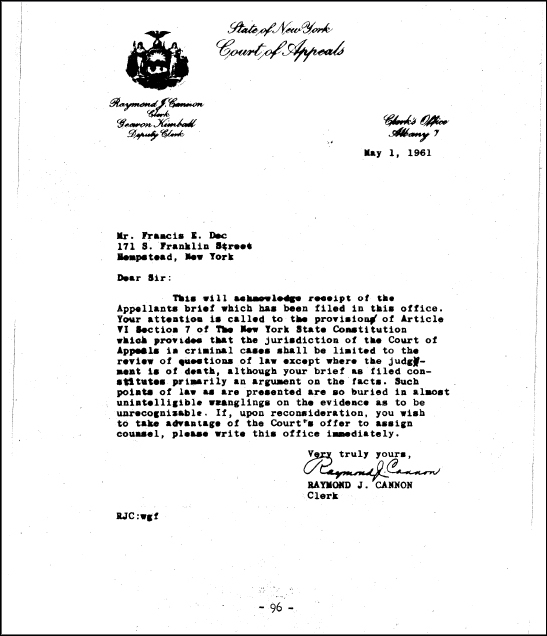 [CLICK HERE TO READ THE SECOND OF THE ABOVEMENTIONED TWO INSERTED LETTERS FROM THE CLERK OF THE NASSAU COUNTY APPEAL COURT, OFFERING DEC LEGAL COUNCIL.] |
|
Dated: September 21, 1961. |
|
| APPENDIX | |
 [CLICK HERE TO READ PAGE ONE OF DEC'S INSERTED APPENDIX TO HIS SUPREME COURT APPEAL.] |
 [CLICK HERE TO READ PAGE TWO OF DEC'S INSERTED APPENDIX TO HIS SUPREME COURT APPEAL.] |




 During the trial it was obvious that the cardinal count of
the
indictment was the third count, namely, grand larceny in the
second degree, allegedly based on the larceny of $400 from Allstate
Insurance Company through false pretenses; actually committed
by the
admitted felonious culprit, Mrs. Elizabeth Wirschning, in
collusive
conspiracy with her husband Frederick Wirschning and
assisted by Dr.
Milton E. Robbins. These facts are definitely proven
through the
many repeated admissions even the fraudulently altered
trial minutes
still contain. Mrs. Elizabeth Wirschning’s testimony
confirms that
this defendant was her legally retained lawyer and
that:
During the trial it was obvious that the cardinal count of
the
indictment was the third count, namely, grand larceny in the
second degree, allegedly based on the larceny of $400 from Allstate
Insurance Company through false pretenses; actually committed
by the
admitted felonious culprit, Mrs. Elizabeth Wirschning, in
collusive
conspiracy with her husband Frederick Wirschning and
assisted by Dr.
Milton E. Robbins. These facts are definitely proven
through the
many repeated admissions even the fraudulently altered
trial minutes
still contain. Mrs. Elizabeth Wirschning’s testimony
confirms that
this defendant was her legally retained lawyer and
that: This defendant’s indictment alleged a $400 larceny
from Allstate Insurance Company by use of false and fraudulent representations and pretenses by this defendant. Allstate Insurance
Company singled this defendant out and
complained of the said
alleged $400 larceny. Mrs. Wirschning
did state her entire medically
treated personal injury claim to
the Allstate Insurance Company
doctor, Joseph Rosenheck,
on May 24, 1956, during Dr. Rosenheck’s private medical
examination of her claimed injured parts of her body
(Defendant’s Exhibit I in Evidence) and she later confirmed
her
personally stated injury claim to the Allstate Insurance Company
officers in her signed statements
of complaint in February 1957
(500). This fact was confirmed by the Allstate Insurance Company
complete up to date of trial injury claim file on Mrs. Elizabeth
Wirschning’s injury claim (460-461).
The Allstate Insurance Company
evaluated and settled Mrs. Wirschning’s injury claim for $400 on
only
Mrs. Wirschning’s personally stated detailed injuries, namely,
bursitis of her right shoulder and bruises
of her right thigh;
without said personally stated claims of doctor treated injuries by
Mrs. Wirschning
there could not be a settlement made and only
through evaluating these stated doctor treated injuries
stated by
Mrs. Wirschning during her said medical examination by the Allstate
Insurance Company
doctor, Dr. Rosenheck, did the Allstate Insurance
Company set up a cash reserve for Mrs.
Wirschning’s injury claim and
only because of Mrs. Wirschning’s said stated doctor treated injury
claim did Allstate Insurance Company offer $400 in settlement of her
injury claim. Up to the date of
trial Mrs. Wirschning stated no
other injuries and she, Mrs. Wirschning, never contradicted these
injuries as her total doctor treated injury claim according to the
Allstate Insurance Company complete
file on her injury claim. The
Allstate Insurance Company paid the sum of $400 in settlement of
Mrs.
Wirschning’s claim in order to be free from all legal
obligations in reference to the said Mrs. Wirschning personally
stated injury claim. At the time of this defendant’s trial and up to
the present date,
which is after the expiration of the statute of
limitations, the Allstate Insurance Company has been
free from all
legal obligations in reference to the Elizabeth Wirschning injury
claim in accordance with
the $400 settlement. This was made possible
solely through the evaluation by the officers of Allstate
Insurance
Company of Mrs. Wirschning’s claims of injuries for which she
claimed she received eight treatments from a doctor during eight
visits to the doctor’s office; when she was asked the nature of
her
injury claim by Dr. Joseph Rosenheck on behalf of Allstate Insurance
Company on May 24, 1956,
Mrs. Elizabeth Wirschning stated:
This defendant’s indictment alleged a $400 larceny
from Allstate Insurance Company by use of false and fraudulent representations and pretenses by this defendant. Allstate Insurance
Company singled this defendant out and
complained of the said
alleged $400 larceny. Mrs. Wirschning
did state her entire medically
treated personal injury claim to
the Allstate Insurance Company
doctor, Joseph Rosenheck,
on May 24, 1956, during Dr. Rosenheck’s private medical
examination of her claimed injured parts of her body
(Defendant’s Exhibit I in Evidence) and she later confirmed
her
personally stated injury claim to the Allstate Insurance Company
officers in her signed statements
of complaint in February 1957
(500). This fact was confirmed by the Allstate Insurance Company
complete up to date of trial injury claim file on Mrs. Elizabeth
Wirschning’s injury claim (460-461).
The Allstate Insurance Company
evaluated and settled Mrs. Wirschning’s injury claim for $400 on
only
Mrs. Wirschning’s personally stated detailed injuries, namely,
bursitis of her right shoulder and bruises
of her right thigh;
without said personally stated claims of doctor treated injuries by
Mrs. Wirschning
there could not be a settlement made and only
through evaluating these stated doctor treated injuries
stated by
Mrs. Wirschning during her said medical examination by the Allstate
Insurance Company
doctor, Dr. Rosenheck, did the Allstate Insurance
Company set up a cash reserve for Mrs.
Wirschning’s injury claim and
only because of Mrs. Wirschning’s said stated doctor treated injury
claim did Allstate Insurance Company offer $400 in settlement of her
injury claim. Up to the date of
trial Mrs. Wirschning stated no
other injuries and she, Mrs. Wirschning, never contradicted these
injuries as her total doctor treated injury claim according to the
Allstate Insurance Company complete
file on her injury claim. The
Allstate Insurance Company paid the sum of $400 in settlement of
Mrs.
Wirschning’s claim in order to be free from all legal
obligations in reference to the said Mrs. Wirschning personally
stated injury claim. At the time of this defendant’s trial and up to
the present date,
which is after the expiration of the statute of
limitations, the Allstate Insurance Company has been
free from all
legal obligations in reference to the Elizabeth Wirschning injury
claim in accordance with
the $400 settlement. This was made possible
solely through the evaluation by the officers of Allstate
Insurance
Company of Mrs. Wirschning’s claims of injuries for which she
claimed she received eight treatments from a doctor during eight
visits to the doctor’s office; when she was asked the nature of
her
injury claim by Dr. Joseph Rosenheck on behalf of Allstate Insurance
Company on May 24, 1956,
Mrs. Elizabeth Wirschning stated:
 This defendant’s trial was
worse than any gestapo trial
in
Europe during the Nazi Regime,
with a total disregard of
defendant’s Constitutional Rights to an
impartial fair trial. This
defendant repeatedly so complained
but defendant’s complaints have
been fraudulently deleted from
the record and only a few words
of
the defendant’s repeated
condemnation of the gestapo like
farce
trial of this defendant remain
(127-135, 836, 839, 845).
Defendant repeatedly complained
about the prejudicial false
statements and
testimony of the lying imp judge, W’m Sullivan, who
assisted the prosecution throughout the trial.
In efforts to
overcome the nearly irrebuttable presumption
of regularity favoring
this dishonest judge, the
defendant finally, in accord with all
rules of evidence
repeatedly petitioned that in order to confirm the
falsehoods and lies of the judge, W’m Sullivan,
in accordance with
defendant’s petitions:
This defendant’s trial was
worse than any gestapo trial
in
Europe during the Nazi Regime,
with a total disregard of
defendant’s Constitutional Rights to an
impartial fair trial. This
defendant repeatedly so complained
but defendant’s complaints have
been fraudulently deleted from
the record and only a few words
of
the defendant’s repeated
condemnation of the gestapo like
farce
trial of this defendant remain
(127-135, 836, 839, 845).
Defendant repeatedly complained
about the prejudicial false
statements and
testimony of the lying imp judge, W’m Sullivan, who
assisted the prosecution throughout the trial.
In efforts to
overcome the nearly irrebuttable presumption
of regularity favoring
this dishonest judge, the
defendant finally, in accord with all
rules of evidence
repeatedly petitioned that in order to confirm the
falsehoods and lies of the judge, W’m Sullivan,
in accordance with
defendant’s petitions:

 This citizen as a practicing lawyer had become aware of the sacrosanct right of the judiciary
to fraudulently alter trial records to the desires of the
judiciary. In order to thwart the complete fraudulent
alteration of this citizen’s trial record this citizen
purposefully testified at length and repeatedly during
his trial. The extant remaining fraudulently altered trial
minutes are nine hundred and ninety one (991) pages long.
Inadvertently, a few of the impish derogatory statements by
the trial judge against this citizen are left in the extant trial
minutes. Part of one such derogatory statement of the trial
judge is found on pages 159-160 after this citizen complained
of the trial judge’s lengthy character testimony for the District
Attorney’s stenographer and the District Attorney’s
fraudulently
altered stenographic notes; during which character
testimony
the trial judge attempted
to coerce this citizen into allowing the fraudulently altered
stenographic notes;
during which character
testimony the trial judge attempted to coerce this citizen into
allowing the
fraudulently altered District
Attorney’s stenographer’s stenographic notes into evidence without
this
citizen examining them. The
trial judge ordered this citizen to discontinue his objections to
the
trial judge’s prearranged
false character testimony. This citizen objected and stated “under
our law I am forced to
proceed when your Honor denies me the right to object” (159).
The
Court then stated: “The
Court feels that everybody here is well advised of what we are
contending with…proceed
from that point” (160). Laconically in the extant trial minutes the
dishonest, imp, fop, hold-over judge, William J. Sullivan, wantonly reiterated the coercive
warning of Judge Philip
Kleinfeld of the Appellate Division of the Supreme Court for the
Second Judicial Department,
namely, that “the judge and jury are fixed” and this citizen’s
trial
would lead to a “terrible
prison sentence”.
This citizen as a practicing lawyer had become aware of the sacrosanct right of the judiciary
to fraudulently alter trial records to the desires of the
judiciary. In order to thwart the complete fraudulent
alteration of this citizen’s trial record this citizen
purposefully testified at length and repeatedly during
his trial. The extant remaining fraudulently altered trial
minutes are nine hundred and ninety one (991) pages long.
Inadvertently, a few of the impish derogatory statements by
the trial judge against this citizen are left in the extant trial
minutes. Part of one such derogatory statement of the trial
judge is found on pages 159-160 after this citizen complained
of the trial judge’s lengthy character testimony for the District
Attorney’s stenographer and the District Attorney’s
fraudulently
altered stenographic notes; during which character
testimony
the trial judge attempted
to coerce this citizen into allowing the fraudulently altered
stenographic notes;
during which character
testimony the trial judge attempted to coerce this citizen into
allowing the
fraudulently altered District
Attorney’s stenographer’s stenographic notes into evidence without
this
citizen examining them. The
trial judge ordered this citizen to discontinue his objections to
the
trial judge’s prearranged
false character testimony. This citizen objected and stated “under
our law I am forced to
proceed when your Honor denies me the right to object” (159).
The
Court then stated: “The
Court feels that everybody here is well advised of what we are
contending with…proceed
from that point” (160). Laconically in the extant trial minutes the
dishonest, imp, fop, hold-over judge, William J. Sullivan, wantonly reiterated the coercive
warning of Judge Philip
Kleinfeld of the Appellate Division of the Supreme Court for the
Second Judicial Department,
namely, that “the judge and jury are fixed” and this citizen’s
trial
would lead to a “terrible
prison sentence”.

|
|
||
|
SCANS OF ORIGINAL
BRIEF (.PDF) PART 1 | PART 2 | PART 3 | PART 4 | PART 5 | ADDENDUM MANY THANKS TO TED TORBICH FOR OBTAINING DEC'S SUPREME COURT APPEAL! |
||
 |
 |
|

More features by zer0:
 |
 |
 |
 |
|||
|
Main Page |
Bento & Starchky - the Online Comic! |
Bob the Corpse - An Online Comic! |
Stop on by and chat in the forum! |
This page created and maintained worldwide as a
Frankenstein
slave
(usually at night) by zer0
(Peter Branting) 2006 and onwards.
Original rants by Francis E. Dec, esq.
Audio
recorded by Boyd "Doc" Britton,1986
All illustrations
© by zer0, 2006 and
onwards. Quit stealing
other people's stuff, eBaum.
*
- -THE
OFFICIAL FRANCIS E DEC FANCLUB -- "Its a pak o' lies, WHERE'S 'IZ
PROOF?!" - -